
Letters From Quotidia Episode 13 Starting Over Again

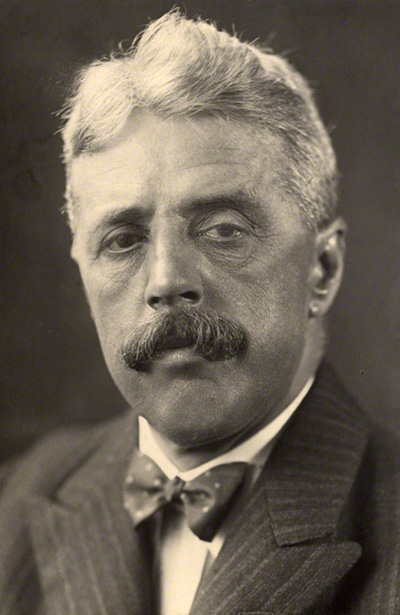
Welcome to Letters From Quotidia – a podcast by Quentin Bega for lovers of music, poetry, and the Crack- that most Irish of nouns which may encompass, news, gossip, fun, entertainment, and enjoyable conversation. Quotidia is that space, that place, where ordinary people lead ordinary lives. But where, from time to time, they encounter the extraordinary. In this letter we dip a toe into the treacherous stream of quantum mechanics, explore the topic of optimism via that enlightenment era novella by Voltaire, Candide, and conclude with some words of wisdom from that genial English novelist, Arnold Bennett.

Why we ever think about a new start must be hard-wired into the genome. The eternal optimists among us come up with phrases such as, This is the first day of the rest of your life and Every cloud has a silver lining. Which is as valid a philosophical point of view as any, I suppose.

But, if there are causal connections linking every aspect of existence then this view is nonsensical. To illustrate- let’s reduce the universe to your bare foot resting on the ground and a house brick poised thirty-two feet above it. Now, let the brick accelerate downwards subject to the earth’s normal gravitational force. In about one second you will be screaming in pain. Quantum mechanics, however, will rush into the fray to assure you that indeterminism is woven into the fabric of the universe, so, perhaps, that brick, which, when last we saw it, was hurtling towards your unprotected toes, gathering momentum and kinetic energy on its way, will transform into a shower of rose-petals just before impact. In which case, you may, and with some justice, feel inclined to take the time to smell the flowery fragments.

Better this, than shelling out hard-won cash on diet books and self-help courses which sell in huge quantities as a testimonial to the optimistic hard-wiring of most of the human species. Let us, then, turn to literature to expand on these matters. Professor Pangloss in Voltaire’s Candide is definitely a glass-half-full kind of guy. He is the learned tutor to the eponymous hero. They live a blissful life until Candide makes the mistake of kissing, Cunegonde, the beautiful and desirable daughter of the owner of their luxurious castle and surrounding garden. In the time between their expulsion from their paradisial abode at the novella’s start and the garden in which they find themselves at the conclusion, Pangloss and, separately, his naïve charge, Candide, undergo a series of improbable adventures including a scene in Lisbon Harbour where the one-eyed-one-eared-syphilitic tutor, now reunited with his erstwhile pupil (didn’t I mention a series of improbable adventures?) assures Candide that the tragic drowning of a friend, Jacques, who had saved him from being lynched, was quite in keeping with the Panglossian world view, which is summed up in the words: we live in the best of all possible worlds.

Pangloss goes on to state authoritatively that Lisbon Harbour was, in fact, created in order that Jacques could drown therein. Now I don’t want to place too many spoilers in the way of those who may wish to peruse the original work either in French or in translation but here are a few titbits to whet your appetite. Cunegonde and Candide are re-united where he learns she has survived rape and disembowelment (need I say “improbably”, again?). She incautiously whinges about this to an old woman who retorts that she had to suffer loss of a buttock to feed some starving men. Candide, separated a second time from his love, finds himself in El Dorado where a life of fulfilment and riches are on offer. But Candide, pining for Cunegonde, sets out in search of her with lots of loot which, of course, he mostly loses along the way. Learning of her location in Turkey where she is enslaved and hideously ugly because of the privations she has endured along the way, he proceeds there and purchases her freedom. With the last of his money, he buys a plot of land after seeking guidance from a Turkish farmer who tells him, “I have no more than twenty acres of ground, the whole of which I cultivate myself with the help of my children; and our labour keeps off from us three great evils — idleness, vice, and want.”

The Age of Enlightenment precedes the Romantic Era, but here we find a situation that would have appealed to Wordsworth. The last sight we have of Candide and his companions finds that they are tending their garden, leaving the concerns of the wider world to someone else. However, the final word goes to another author, one Arnold Bennett, the author of the magnificently titled, The Grand Babylon Hotel. He has this to say about the nature of time: The chief beauty about time/is that you cannot waste it in advance. /The next year, the next day, the next hour are lying ready for you,/as perfect, as unspoiled,/as if you had never wasted or misapplied a single moment in all your life./ You can turn over a new leaf every hour/if you choose. I’ll admit to being attracted to his views on life. He gives his writing formula, which also appeals, without demur: I put in genuine quantities of wealth, luxury, feminine beauty, surprise, catastrophe and genial incurable optimism. And, as to why he wrote so much: Am I to sit still and see other fellows pocketing two guineas apiece for stories which I can do better myself? Join me in podcast number 14, where I will charge in where angels fear to tread: the battle between the sexes (on second thoughts, maybe ‘ll think twice?) But most certainly I will visit Macbeth during a bloody solicitation, cite a poem by Carol Ann Duffy, where a man wakes up as a woman, and learn what the 2nd Century commentator, Lucian of Samosata, had to say about the fledgling cult of Christianity. Spoiler alert- he wasn’t very complimentary. So join me, then, for the next letter from  that vast land of Quotidia.

Credits: All written text, song lyrics and music (including background music) written and composed by Quentin Bega unless otherwise specified in the credits section after individual posts. Illustrative excerpts from other texts identified clearly within each podcast. I donate to and use Wikipedia frequently as one of the saner sources of information on the web.

Technical Stuff: Microphone- (for the podcast spoken content) Audio Technica AT 2020 front-facing with pop filter

Microphone (for many of the songs) Shure SM58

For recording and mixing down 64-bit N-Track Studio 9 Extended used

Music accompaniment and composition software– Band-in-a-Box and RealBand 2020 as well as- for some 20 of the songs of year 2000 vintage- I used a Blue Mountains, NSW, studioApproximately 48 Banter folk songs and instrumentals recorded live (“in the round”) with a ThinkPad laptop using the inbuilt mic.

Letters From Quotidia Postcards Edition Number 3

Postcards Edition Number 3

Welcome to Letters From Quotidia, the Postcards edition, number 3, a podcast by Quentin Bega where you will hear Banter, a traditional Irish folk group from Sydney’s outer west, present four tunes and songs drawn from the traditions of the English-speaking world. And, as always, Quotidia is that space, that place, where ordinary people lead ordinary lives. But where, from time to time, they encounter the extraordinary.

Our first offering is instrumental: The Grand Old Duke/Heel and Toe Polkas– In Banter, we love bashing out lively tunes such as the pair presented here. As well as tacking on various reels, jigs and hornpipes to our songs, we enjoy focusing from time to time on the great instrumental repertoire available to aficianados of Irish music. The Heel and Toe Polka is a great favourite of Aussie Bush Bands and I can remember, at the turn of the millenium, watching people dancing up and down the main street of Gulgong to the accompaniment of the tune, my wife and daughter among the whirling dervishes. Who or what is The Grand Old Duke– of York? Or is it more likely to be a pub? I would go for the latter, but I just don’t know. Listen and decide for yourself. [insert tunes]

It is 1816, a sailing ship limps past Roche’s Point, its rigging all torn. Exhausted mariners, returning after months at sea, perform their duties in desultory fashion but begin to perk up as they round Spike Island and spot the rows of terraces rising above the quay in Cove. They swarm ashore and make for the places of entertainment for lonely and thirsty sailors in the section of town known as The Holy Ground. Soon they make the rafters roar with their shouts and songs, calling for strong ale and porter as the serving girls move among them, sometimes tumbling into the willing lap of a lusty tar. This is part of a post I published five years ago when the world was a different place.

The Holy Ground exists outside the lusty taverns of 19th Century, Cork. There is sacred ground everywhere, and some, say with the perspective of astronauts looking back at the blue dot from the vastness of space, would characterise all of this earth as holy or sacred ground. That so much of it (to say nothing of the waters around and flowing through it; or the air which passes over it) is despoiled by violence and pollution and injustice makes one wonder if Gaia herself is unleashing pestilence such as SARS-CoV-2 to teach us a salutary lesson. And so, from lockdown, I present another song that, Deo volente, we, as the group, Banter, will be able to play again in public. These songs are nothing like the real songs which are played in front of crowds enjoying the moment- but, perhaps, it is better than silence. [insert song]

Now for Joe Hill– This great union song has been a part of my musical experience for many decades now and I am still moved by its defiant and uplifting message. Before his execution by firing squad in Utah in November 1915, Joe Hill mordantly declared, in a note to IWW leader Bill  Haywood, “Could you arrange to have my body hauled to the state line to be buried? I don’t want to be found dead in Utah.” His will is also worth recording, My will is easy to decide/For there is nothing to divide/My kin don’t need to fuss and moan/”Moss does not cling to rolling stone”/My body? Oh, if I could choose/I would to ashes it reduce/And let the merry breezes blow/My dust to where some flowers grow/Perhaps some fading flower then/Would come to life and bloom again./This is my Last and final Will./Good Luck to All of you/Joe Hill. What a magnificent sentiment. [insert song]

I first heard Her Father Didn’t Like Me, Anyway, from the singing of Eddie Furey and piping by Finbar, from, their Transatlantic LP The Dawning of the Day, released in 1972. Written by Gerry Rafferty (he wrote 1978s smash hit Baker Street from his LP City to City and Stuck in the Middle with You, later used in the ear-cutting scene from the film Reservoir Dogs.) He died in 2011 after a varied and jam-packed career and, as happens to so many talented musos, after a long struggle with alcohol. Finbar Furey, who knew Rafferty for over 40 years, said he “was in a different league completely. He didn’t know how good he was. He was one of the most talented musicians and singers I ever knew but he completely underestimated his own talent. He was a very humble man.”

I include the above, gleaned from Wikipedia, as a tribute to a truly great talent. To any listener who fondly thinks they are in the presence of a Brainiac of Polymathic Prodigiousness. Nah, I’m pretty ordinary but I use and donate to that great online resource to kit myself out in learned clothing. [insert song] That has been the third postcard from Quotidia. And, again, isn’t it peculiarly Irish that the postcards are longer than the Letters From Quotidia. Ah well! Our next edition of postcards will feature 3 sea captains, a contested river, green hills and a wild rover. So, join me, then, for another foray into the fabulous arena that is, folk music. 

Credits: All written text, song lyrics and music (including background music) written and composed by Quentin Bega unless otherwise specified in the credits section after individual posts. Illustrative excerpts from other texts identified clearly within each podcast. I donate to and use Wikipedia frequently as one of the saner sources of information on the web.

Technical Stuff: Microphone- (for the podcast spoken content) Audio Technica AT 2020 front-facing with pop filter

Microphone (for many of the songs) Shure SM58

For recording and mixing down 64-bit N-Track Studio 9 Extended used

Music accompaniment and composition software– Band-in-a-Box and RealBand 2020 as well as- for some 20 of the songs of year 2000 vintage- I used a Blue Mountains, NSW, studioApproximately 48 Banter folk songs and instrumentals recorded live (“in the round”) with a ThinkPad laptop using the inbuilt mic.
Letters From Quotidia Episode 12 Surprised By Joy

Welcome to Letters From Quotidia – a podcast by Quentin Bega for lovers of music, poetry, and the Crack- that most Irish of nouns which may encompass, news, gossip, fun, entertainment, and enjoyable conversation. Quotidia is that space, that place, where ordinary people lead ordinary lives. But where, from time to time, they encounter the extraordinary. This 12th podcast looks at such contrasting art-forms as Full Metal Jacket and a Wordsworth sonnet as well as lifestyle shows that perform charitable acts for the camera and ratings and an anecdote concerning the English poet Philip Larkin.

Elegaic song and verse have long exerted a fascination for me. Even before my life was touched by personal tragedy, I was drawn to artistic works that explored eschatological themes. For those of you who are unfamiliar with the word, I do not mean to be unduly obscurantist, nor should you confuse the term with scatological which deals with excremental matters; although, when I reflect upon it, there may be a connection. Can you remember the film, Full Metal Jacket, at the very end, when Private Joker, surviving the horrors of Vietnam, makes a comment about living in a world of excrement.

He uses the s word which I can’t use without using an explicit tag for this podcast-go figure! So many traumatised people would echo his words: military men and women returned from conflict zones, paramedics, police officers, firies and emergency first responders as well as those benighted individuals who do not have the excuse of having served in such capacities but who just have encountered the black dog of depression in their lives and can’t get rid of it.

The four last things: death, judgement, heaven and hell are the territory of eschatology and really only an issue for believers who profess that there is meaning in this universe. Others would simply say it’s random and there’s nothing else. This view I respect even though I do not share it. For me, I have been surprised by joy too many times to feel otherwise. A formation of clouds, a smile, a kindly word, an unexpected compliment, a breath of fresh air, a hug from a child- on and on I could go, perhaps writing the hit lyrics of a saccharine country song. But, instead, I turn to one of my literary heroes, William Wordsworth, to give these thoughts proper context when he reflects on what it is that is important in the larger scheme of things. He talks about, that best portion of a good man’s life, / His little, nameless, unremembered acts of kindness and of love.

What a dreadful proposition this would be to the players in today’s media circus. Good deeds unreported! I cannot open a newspaper or magazine, switch on a current affairs or lifestyle show without being bombarded with a barrage of overwhelming acts of charity as homes are refurbished, holidays provided, reunions facilitated and medical miracles accomplished in the glare of publicity and attendant advertising. Not that I begrudge, in any way, the recipients of this largesse. I do feel for the numberless and nameless who will never benefit. Name, fame, the celebrity game is just so much blather. We are all used to yet another icon exposed on the breakfast news as venal or sad or pathetic- just like us really.

I remember when the great cynic of English poetry in the previous, century, Philip Larkin was taken off in one of those ships with black sails. Almost before the vessel had vanished around a misty bend of the River Styx we were breathlessly informed that the poet had a collection of what was described as repulsive pornography, and as for the content of his diaries…well! But I will always think softly of him, not only because of the quality of the poetry that he produced but an anecdote concerning him. He was, as I recall, driving back towards his home in Hull along the motorway, listening to the radio and tapping his fingers on the steering wheel in time with the windshield wipers when he had to pull onto the hard shoulder, blinded by tears, because, on the radio, someone had begun reciting a sonnet by Wordsworth:

Surprised by joy- impatient as the Wind/I turned to share the transport- Oh! With whom/ But Thee, deep buried in the silent tomb, / that spot which no vicissitudes can find? / Love, faithful love, recalled thee to my mind-/But how could I forget thee? Through what power, / Even for the least division of an hour, /Have I been so beguiled as to be blind/to my most grievous loss! – That thought’s return/Was the worst pang that sorrow ever bore,/Save one, one only, when I stood forlorn,/Knowing my heart’s best treasure was no more;/That neither present time, nor years unborn/Could to my sight that heavenly face restore.

The song, Surprised by Joy, was performed only once in public, at the newly opened Penrith Gaels club in Sydney in 1997. Unfortunately, I had neglected to tell my wife about this song, which had just been written. Indeed, the decision to sing it was spur-of-the-moment. As she listened to the lyrics, she realised the context and left the venue in tears. When she asked me later if the dream detailed in the song, Surprised by Joy, had been a real dream, I admitted that, no, it was just an idea I had for writing a song- but true, just the same- truer, perhaps, because it was not dredged from the unconscious sludge of my mind but that I dreamed the whole thing consciously as I beat the red-hot iron in the smithy of my waking imagination, feeling with each blow, the pain of loss but persevering nonetheless to produce an elegy that would serve:[insert song Surprised by Joy] Join me next time for a trawl through the sunlit seas of the topic-Optimism as we sail past Voltaire and his splendid novel, Candide, and pull up at The Grand Babylon Hotel.

Credits: All written text, song lyrics and music (including background music) written and composed by Quentin Bega unless otherwise specified in the credits section after individual posts. Illustrative excerpts from other texts identified clearly within each podcast. I donate to and use Wikipedia frequently as one of the saner sources of information on the web.

Technical Stuff: Microphone- (for the podcast spoken content) Audio Technica AT 2020 front-facing with pop filter

Microphone (for many of the songs) Shure SM58

For recording and mixing down 64-bit N-Track Studio 9 Extended used

Music accompaniment and composition software– Band-in-a-Box and RealBand 2020 as well as- for some 20 of the songs of year 2000 vintage- I used a Blue Mountains, NSW, studioApproximately 48 Banter folk songs and instrumentals recorded live (“in the round”) with a ThinkPad laptop using the inbuilt mic.

Letters From Quotidia Episode 11 The Mark of Cain

Welcome to Letters From Quotidia – a podcast by Quentin Bega for lovers of music, poetry, and the Crack- that most Irish of nouns which may encompass, news, gossip, fun, entertainment, and enjoyable conversation. Quotidia is that space, that place, where ordinary people lead ordinary lives. But where, from time to time, they encounter the extraordinary.  In podcast 11 crime takes centre stage as we wander from the first crime recorded in Genesis through murders in ancient Greece and Rome and the Ottoman Empire to a Shakespearean examination of the topic as well as how it is treated in 20th Century popular culture.

The first crime recorded in Genesis is homicide or, more specifically, fratricide. But this is not the first sin: that preceded the crime. Milton puts it most memorably in the opening lines of the great Paradise Lost: Of Man’s first disobedience, and the fruit Of that forbidden tree whose mortal taste Brought death into the World, and all our woe, With loss of Eden, till one greater Man Restore us, and regain the blissful seat, Sing Heavenly Muse, that, on the secret top Of Oreb, or of Sinai, didst inspire That shepherd who first taught the chosen seed In the beginning how the heavens and earth rose out of Chaos.

The mortal taste of the forbidden fruit results in the expulsion from Eden and we find Adam and Eve wandering east of Eden dressed in garments of skin. God places an angel with a flaming sword at the entrance to the garden to prevent the pair, who now have knowledge of good and evil, from returning to eat from the tree of life and thus become immortal.

God had cursed the deceiving serpent and also the ground so that humanity would have to struggle against weeds and blight to bring forth sustenance: as the King James version puts it: cursed is the ground for thy sake; in sorrow shalt thou eat of it all the days of thy life;Thorns also and thistles shall it bring forth to thee; In the sweat of thy face shalt thou eat bread, till thou return unto the ground; for out of it wast thou taken: for dust thou art, and unto dust shalt thou return.

Interesting, from the point of view of a contemporary audience, is the paucity of detail surrounding the murder of Abel by his brother Cain. We are used to printed and visual texts going into minute detail about motivation and the process leading up to the act of murder itself. Basically all we are told is that God accepted Abel’s offering over Cain’s. Cain gets in a snit. Then they go out into the field where, in the words of the King James Bible, Cain rose up against his brother Abel, and slew him.

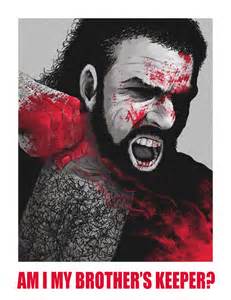
That’s it. Nothing more. The aftermath is more detailed, of course. When God enquires after Abel, Cain replies with the famous line: Am I my brother’s keeper? God then condemns Cain to roam the earth as a fugitive and a vagabond, unable to till the ground as it has drunk the blood of his brother. When Cain complains that he will be a marked man (and here we need not examine too closely where the other people who would harm Cain might have come from) God replies: Whosoever slayeth Cain, vengeance shall be taken on him sevenfold. And the LORD set a mark upon Cain, lest any finding him should kill him. So, originally the mark of Cain was divine protection!

Fratricide has been a feature of legend, history and society from this time: In The Antigone, by Sophocles, Eteocles and Polyneices kill each other by stabbing one another through the heart; Romulus kills Remus and founds the city of Rome- setting the stage for lots of family killings down through the centuries. In Hamlet, Claudius kills his brother, the king to grab the throne and Queen Gertrude. At about the same time as the composition of Hamlet, it was not a recipe for long life to be the brother of the Sultan of the Ottoman Empire. In the reign of Mehmet III, upon the birth of a male heir to the throne, nineteen of his brothers were strangled with silk cords and buried with their father. In contemporary popular culture, Michael Coreleone kills his brother in The Godfather, Part Two and, in Disney’s The Lion King, Scar kills his brother Mufasa.

In the mid-1980s, I had been successful in writing a TV and a radio drama for the Irish broadcaster, RTE, both of which incorporated music as part of the drama. I then started to write a TV show for Ulster TV called The Last Country Band in Ireland, and as a preparation for this I had listened to countless hours of country music from Ireland and the US. The show was to open with a showdown using the cliché of two gunslingers facing one another in a western setting- saloon bar, horse stables, goods store, sheriff’s office and frontier damsels with handkerchiefs raised in horror to their faces. The song would play over the opening sequence leading to the shoot-out, when the camera would pan back and we would see the backdrop to be a contemporary Ulster setting.

I had a lunchtime meeting with one of the station’s producers and everything seemed promising. Then, the opportunity to return to Australia fell in my lap and, with only six months to avail myself of this prospect, I did not have time to complete the script and the process and make the arrangements for the move back to Australia. But I did have the time to write a few songs in the genre. I had chosen this song to open the show, which, like too many other ideas, lies stillborn in a file somewhere in the loft or garage. But here’s the song: [insert song The Mark of Cain] The next podcast brings up a round dozen of the genre and it marks the occasion by referencing Full Metal Jacket as well as a recitation of a full Wordsworth sonnet, among other things- so stick around for our next essay in going high and going low. 

Credits: All written text, song lyrics and music (including background music) written and composed by Quentin Bega unless otherwise specified in the credits section after individual posts. Illustrative excerpts from other texts identified clearly within each podcast. I donate to and use Wikipedia frequently as one of the saner sources of information on the web.

Technical Stuff: Microphone- (for the podcast spoken content) Audio Technica AT 2020 front-facing with pop filter

Microphone (for many of the songs) Shure SM58

For recording and mixing down 64-bit N-Track Studio 9 Extended used

Music accompaniment and composition software– Band-in-a-Box and RealBand 2020 as well as- for some 20 of the songs of year 2000 vintage- I used a Blue Mountains, NSW, studioApproximately 48 Banter folk songs and instrumentals recorded live (“in the round”) with a ThinkPad laptop using the inbuilt mic.

Letters From Quotidia Episode 10 Easter Rises

Easter Rises

Entry 10: Easter Rises Welcome to Letters From Quotidia – a podcast by Quentin Bega for lovers of music, poetry, and the Crack- that most Irish of nouns which may encompass, news, gossip, fun, entertainment, and enjoyable conversation. Quotidia is that space, that place, where ordinary people lead ordinary lives. But where, from time to time, they encounter the extraordinary.  

For my tenth excursion into podcast territory, I’ll have a look into the ravening maw of consumerism and seek a vaccine by calling on Wordsworth to inoculate me with some lines from the Immortality Ode.

I am quite taken by that thoughtful Quaker belief, “the testimony against the keeping of times and seasons” which states that all of life is sacramental; that since all times are therefore holy, no time should be marked out as more holy; that what God has done for us should always be remembered.

Not that I have ever followed this practice: caught in the coils of commercialism, having been harried by the pester power of the kids over the years, having the state of my kitchen, bathroom, bedroom, laundry, study- let’s face it, every nook and cranny of my dwelling, not to mention the garden shed and garage- sneered at by renovation shows and lambasted by lifestyle mavens, I have long since capitulated to capitalism’s handmaiden- commercialism.

There is scarcely a week in the year that is not marked by some “occasion” for marketing: New Year’s sales in January, Valentine’s Day in February, mad March sales, Easter eggs in April, Mother’s Day in May- the list goes on. Did I mention Father’s Day, Halloween and Christmas? I look in vain in the shopping centres for businesses that are not having a sale. Hang on a minute- I do believe that market forces are on the way to levelling the days and weeks of the year to the Quaker ideal of no day being marked out as more special than any other. Just one gigantic sales frenzy from January 1st through to December 31st.

But, to tell you the truth, certain days have always been red-letter days for me, and I know, for most other people. Birthdays: one’s own and those of friends and those you love; anniversaries of one sort or another: weddings, deaths, and special events. For me, Halloween was special, not only because I got to go trick-or-treating as a child and came back with a bag stuffed full with goodies- but because it was also my birthday.

Only Christmas loomed larger as a cornucopia from which myriad gifts spilled in glorious abundance before my childish, avaricious eyes. Then, later, as I watched our children’s glee on birthdays or Christmas over the years, I knew that the market-place was in no imminent danger of going out of business on my account.

The song contrasts Easter in Northern Ireland with Easter in Sydney. The festival occurs in springtime in the northern hemisphere with the re-birth of life an annual miracle. In Sydney, it marks the change to less warm days and longer nights- nothing as dramatic as the fall of leaves which paints the eastern sea board of North America autumnal orange, red and brown.

In Sydney, the traditional four seasons most people in Europe or America, respond to just don’t cut it. Aboriginals will tell you that there are five or six distinct seasons here. Having lived, worked and enjoyed my recreation in largely air-conditioned environments, I have no expertise in this area. But even someone as desensitised as I am to the finer points of the natural world, cannot but be awestruck by the miracle of growth.

The song you will hear at the end of the entry will deal, in part, with our younger, more faithful and innocent selves. Wordsworth captures this so beautifully in the majestic Immortality Ode: There was a time when meadow, grove, and stream,/ The earth, and every common sight, To me did seem Apparelled in celestial light,/ The glory and the freshness of a dream……Our birth is but a sleep and a forgetting:/ The Soul that rises with us, our life’s Star, / Hath had elsewhere its setting, /And cometh from afar: / Not in entire forgetfulness,/And not in utter nakedness, But trailing clouds of glory do we come/From God, who is our home:/Heaven lies about us in our infancy!/Shades of the prison-house begin to close/ Upon the growing Boy……Thanks to the human heart by which we live,/ Thanks to its tenderness, its joys, and fears,/ To me the meanest flower that blows can give/Thoughts that do often lie too deep for tears.

How can you better that? This, of course, is the quandary faced by anyone who presumes to enter the lists against the giants of the Arts. And yet we do, knowing that we suffer by comparison. But, wouldn’t the world be a stranger and more barren place if only the very best in every field of endeavour bothered to show up for any contest? 

That not everyone hits the heights or becomes a star should not prevent one from making the attempt. Having said this, I do think it’s a fraud on the young to suggest that they can do anything at all, if only they put their mind to it. There is a bit more to it than wishful thinking, even if it is supported by ceaseless endeavour. Luck and superior, innate gifts also play an important part.

The bridge of the song describes the impact of the death of my first-born son and how the birth of my younger daughter at Easter-time two years later helped to alleviate the pain and assuage the bitterness and anger I felt: [insert song, Easter Rises]

Legs Eleven would be the way a bingo caller would enumerate the next podcast and if Milton and Genesis are a bit heavy for your tastes, wait around for the pop cultural references to The Godfather and The Lion King.

Credits: All written text, song lyrics and music (including background music) written and composed by Quentin Bega unless otherwise specified in the credits section after individual posts. Illustrative excerpts from other texts identified clearly within each podcast. I donate to and use Wikipedia frequently as one of the saner sources of information on the web.

Technical Stuff: Microphone- (for the podcast spoken content) Audio Technica AT 2020 front-facing with pop filter

Microphone (for many of the songs) Shure SM58

For recording and mixing down 64-bit N-Track Studio 9 Extended used

Music accompaniment and composition software– Band-in-a-Box and RealBand 2020 as well as- for some 20 of the songs of year 2000 vintage- I used a Blue Mountains, NSW, studioApproximately 48 Banter folk songs and instrumentals recorded live (“in the round”) with a ThinkPad laptop using the inbuilt mic.

Letters From Quotidia Episode 9 The Self-Unseeing

Quentin Bega
OLYMPUS DIGITAL CAMERA

Welcome to Letters From Quotidia – a podcast by Quentin Bega for lovers of music, poetry, and the Crack- that most Irish of nouns which may encompass, news, gossip, fun, entertainment, and enjoyable conversation. Quotidia is that space, that place, where ordinary people lead ordinary lives. But where, from time to time, they encounter the extraordinary. Poetry is never far from the Gaelic imagination, and in podcast number nine, The Self-Unseeing, we’ll have a look at two short poems, one by English poet, Thomas Hardy and  the other by American poet, Carl Sandburg

Back in the 1980s, I was teaching at a grammar school in Northern Ireland. The novels of Thomas Hardy were on the curriculum for O and A Levels as they had been when I was at school in the sixties. I was teaching the novels as opposed to learning about them from a teacher droning at the front of the room. Now I was the droner. In a poll, taken in London at the time, Hardy emerged as the most popular author among senior students. I have a high regard for his novels but a higher regard for his poetry, which covers a wide range of forms and subjects. There can be little argument that he is among the greatest of the English poets of the 20th Century because of his adventurous and insightful exploration of what it is to be human.

His poems about his first wife, Emma, were written after her death and an awkward estrangement of twenty long years. They are searing in their remorse and filled with regret and remembered love. Although Hardy could, and did, write about the larger themes such as war, belief, the impact of technology, social constraints and class- it is when he examines the minutiae of family life and personal relationships that he comes into his own.

His poem, The Self-Unseeing, deals with his remembrance of his mother and father and a scene from his boyhood when he was truly happy: Here is the ancient floor, /Footworn and hollowed and thin, /Here was the former door/Where the dead feet walked in. //She sat here in her chair,/Smiling into the fire;/ He who played stood there, /Bowing it higher and higher.//Childlike, I danced in a dream; / Blessings emblazoned that day; / Everything glowed with a gleam; /Yet we were looking away!

It is only after the event that we can truly appreciate how happy we were. Hence the human predilection for rose-tinted glasses, sentimentality and nostalgia. But Hardy avoids the mawkish and the maudlin when he deals with these matters, and this, I suppose, is what makes him a great artist. Aristotle explored in some detail the question of what it means to lead a fulfilled life. He rejects the pursuit of a life of sensual gratification and, also, the pursuit of a life solely concerned with honour. He concludes that Eudaimonia or Happiness satisfies his criteria for the best life.

But unpacking this term in prose would burst the constraints of this podcast- not to mention my aching head! I turn, instead, to Carl Sandburg, a 20th Century American poet, for his mischievous take on this question which he sets out  in his poem entitled, Happiness I asked the professors who teach the meaning of life to tell me what is happiness./And I went to famous executives who boss the work of thousands of men./They all shook their heads and gave me a smile as though I was trying to fool with them/And then one Sunday afternoon I wandered out along the Desplaines river/And I saw a crowd of Hungarians under the trees with their women and children and a keg of beer and an accordion.

This poem strongly resonates with me because it reflects an annual pre-Covid gathering where our family joins family groups of friends and relations for a fish barbecue at a local park. Several generations spend the day celebrating…what? Being alive and in Australia, remembering our culture and those who are absent through geographic separation, work commitments or death.

Shortly before my father died, thirty years ago, I was living and working in Ballymena, which is a market town in Northern Ireland. It was late December, just before Christmas, and it was dark and cold. My sister Mary and her husband, John with their two children, Krista and Monika, had driven across Europe from Munich to visit. The fire was blazing and all the Yuletide decorations were on display. With Mum and Dad, there were ten of us and, at one point in the evening, a guitar was produced and we sang Christmas carols. Then, John taught my kids the verse of Silent Night in German and we listened, entranced, as the four kids sang that sublime song using the original words.

At this time, 100 years ago on the Western Front, all went quiet when the strains of this carol drifted across no man’s land and the fighting men on both sides declared a truce and for one day, a minor miracle. This was against the wishes of the superior officers on the British side. On the German side, a young corporal of the 16th Bavarian Reserve Infantry, was also an opponent of the truce. His name: Adolf Hitler. But on that section of those vast killing fields, peace reigned for a short while. However, this being the world we live in, the fighting resumed and we can only mourn the loss of so many lives on both sides of the conflict. That night in Ballymena, I recall clearly. In the unmistakeable, idiosyncratic diction of Thomas Hardy’s poem, The Self-Unseeing, blessings emblazoned that day. But I, too, was looking away. [insert song The Self-Unseeing] The next podcast rises to double digits and introduces the listener to sales and celebrations and the sublime Immortality Ode

Credits: All written text, song lyrics and music (including background music) written and composed by Quentin Bega unless otherwise specified in the credits section after individual posts. Illustrative excerpts from other texts identified clearly within each podcast. I donate to and use Wikipedia frequently as one of the saner sources of information on the web.

Technical Stuff: Microphone- (for the podcast spoken content) Audio Technica AT 2020 front-facing with pop filter

Microphone (for many of the songs) Shure SM58

For recording and mixing down 64-bit N-Track Studio 9 Extended used

Music accompaniment and composition software– Band-in-a-Box and RealBand 2020 as well as- for some 20 of the songs of year 2000 vintage- I used a Blue Mountains, NSW, studioApproximately 48 Banter folk songs and instrumentals recorded live (“in the round”) with a ThinkPad laptop using the inbuilt mic.
Letters From Quotidia Postcards edition 2

Welcome to Letters From Quotidia, the Postcards edition, number 2, a podcast by Quentin Bega where you will hear Banter, a traditional Irish folk group from Sydney’s outer west, present four tunes and songs drawn from the traditions of the English-speaking world. And, as always, Quotidia is that space, that place, where ordinary people lead ordinary lives. But where, from time to time, they encounter the extraordinary.

For our first item, Mark, our fiddler, pulled this out of the ether as we were thinking about what to record next  in our sessions for Noel, our friend who was returning to Ireland. I vaguely remembered the chords that went along with these tunes (not rocket science really, we’re talking about folk music, after all.) And so we struck up the band!- no, not really, just Mark- and me noodling away while the rest of the company enjoyed yet another refreshing ale! But here I’d like to present King of the Fairies/Queen of the Fairies– Another pair of fine tunes from the Irish instrumental tradition. The fiddle is central to the sound of Banter and it is given due prominence in this brace of melodies.

For me, Michael Hoffman’s 1999 film of Shakespeare’s  Midsummer Night’s Dream with Rupert Everett as Oberon and Michelle Pheiffer as Titania springs to mind when I hear the titles of the tunes now. I have always disliked the greeting-card imagery of fairies and angels as cute-as-buttons homoculi cavorting around petal-strewn gardens or fluffy white cotton-wool clouds. Fairies really are much more fearsome creatures. Cross them at your peril. [insert King of the Fairies/Queen of the Fairies]

 Songs of the sea are a staple of the group. We like the stories and the tunes and the rollicking pace so  many of them possess (such as the case with this example). A belief, common among sailors, was that spotting a mermaid was an omen of impending storm and shipwreck. I have read, somewhere, that Boy Scouts in America sing this song around their campfires (which is no stranger than, say, a bunch of superannuated musos singing it around their grog-laden table…) Here Jim leads the group in a rendition of The Mermaid. [insert song]

Viva la Quinta Brigada  (listed as Viva la Quince Brigada in later recordings) is a Christy Moore song about the Irishmen who fought in the Spanish Civil War against Franco. The title was inspired by a Spanish song about the war,Viva la Quince Brigada. Moore wrote this song choosing to focus on the Irish socialist volunteers (who in later years became known as the Connolly Column) who were a small contingent within the 15th International Brigade. The tune which he used was similar to the version of Viva la Quince Brigada recorded by Pete Seeger and the Almanac Singers in the early 1940s.

The song was inspired by Spanish Civil War veteran Michael O’Riordan’s book Connolly Column.Moore’s original song title – which translates as “Long live the Fifth Brigade” – was a slip due to the similarity in Spanish between “quinta” (fifth) and “quince” (fifteen). Both titles are correct however, originally there were ten brigades in the Spanish army, the five international brigades were then added to the list making the 5th International Brigade the 15th Brigade of the Spanish republic. Name-checked were men from all parts of Ireland, Catholic, Protestant and of no faith, including, a Church of Ireland pastor, Bob Hilliard later became an atheist. In later versions of the song, Christy amended locales of a couple of the people name-checked but I have stuck here to the version I learned a quarter of a century ago. [insert Viva La Quinta Brigada]

Stephen Foster wrote this in 1856- based on an Irish melody. The song went to England, then, later, to Australia where it acquired these lyrics by Lame Jack Cousens of Springhurst, Victoria, who was a travelling thresher. I first heard this sung by Johnny McEvoy c. 1971 in Co. Cork at my brother Jim’s place.

Stephen Foster liked a drink as so many of us do. He died early, of a fever, at the age of 37. The wowsers of the time were quick with the label, drunkard, but somehow managed to overlook the quality and quantity of his song-writing. Thirty years after his death, one reporter described him as paying “the penalty of an irregular life.” So, you see, he had a lot of detractors, of a mind like that anonymous reporter. And, like that reporter, I would imagine that  they are also now unknown nobodies while Stephen Foster lives on in his songs that we, and so many people of good heart, around this wonderful world, sing!

That has been the second postcard from Quotidia. And, again, isn’t it peculiarly Irish that the postcards are longer than the Letters From Quotidia. Ah well! Our next edition of postcards will feature yet more tunes, another song of the sea, a great union song and a cautionary tale for all men . So, join me, then, for another foray into the fabulous arena that is, folk music. 

Credits: All written text, song lyrics and music (including background music) written and composed by Quentin Bega unless otherwise specified in the credits section after individual posts. Illustrative excerpts from other texts identified clearly within each podcast. I donate to and use Wikipedia frequently as one of the saner sources of information on the web.

Technical Stuff: Microphone- (for the podcast spoken content) Audio Technica AT 2020 front-facing with pop filter

Microphone (for many of the songs) Shure SM58

For recording and mixing down 64-bit N-Track Studio 9 Extended used

Music accompaniment and composition software– Band-in-a-Box and RealBand 2020 as well as- for some 20 of the songs of year 2000 vintage- I used a Blue Mountains, NSW, studioApproximately 48 Banter folk songs and instrumentals recorded live (“in the round”) with a ThinkPad laptop using the inbuilt mic.

Letters From Quotidia Episode 8 Sylvia

Welcome to Letters From Quotidia – a podcast by Quentin Bega for lovers of music, poetry, and the Crack- that most Irish of nouns which may encompass, news, gossip, fun, entertainment, and enjoyable conversation. Quotidia is that space, that place, where ordinary people lead ordinary lives. But where, from time to time, they encounter the extraordinary. A product warning- fun and entertainment may be in shorter supply in this, the eighth letter in the series, Sylvia– but I hope there are items of interest along with the pathos.

I first read The Savage God, by A. A. Alvarez, in 1974. This book was the first time I had encountered an examination of the subject of suicide which was actually readable and I found myself gripped by the long section on Sylvia Plath, the American poet who had married Ted Hughes. Now, Hughes I knew, from college lectures, to be a much-admired poet dealing with themes associated with nature and, in particular, the unreflecting savagery of animals- but I knew nothing of his wife’s work.  Seeking out a copy of Ariel, which was published posthumously in 1965, I started reading, and re-reading, those dark and brilliant poems. I also sought out other poems and works by her, including The Bell Jar, a novel which details the female protagonist’s steady mental decline, several suicide attempts, institutionalisation and Electro-Convulsive Therapy. The novel is semi-autobiographical and after a year or so I felt impelled to write a song about her, using images from her poems to help construct the lyric.  The Greek philosopher, Socrates, argued against suicide, for most part, but ended his life by drinking a hemlock-infused potion: a penalty for having been found guilty of corrupting the youth of Athens and impiety. He saw himself as a gadfly, someone who would sting the state into righteous action. Well, the state reacted as we all do when a stinging insect attacks. Kill it or shoo it away!

The Athenian jurors who voted for the death penalty probably thought that Socrates would take the opportunity to flee before the sentence was to be promulgated. Socrates, however, deeming himself to be a true citizen with a horror of life outside the city-state and obedient to the rule of law, drank the hemlock, turned to his friend, Crito, and said I owe a cock to Asclepius, see that the debt is paid. He remains the true ideal of an Athenian citizen, reverencing the gods and punctilious about paying debts. Asclepius, is the god of healing and perhaps Socrates is intimating that death releases the soul from the body and its attendant ills, particularly as one ages.

Four centuries later in Palestine, Judas flings the blood-money he has accepted for his betrayal of Jesus back at the temple priests and hangs himself in despair. They use the tainted money to buy a potter’s field and bury him there. Dante, in The Inferno places Judas in the deepest circle of hell where Satan chews on his head eternally. The Gnostics, on the other hand, reasoning that Judas set in train the salvation of the world, view him as the greatest of all the Apostles. Go figure.

Is there any surprise, though, that one of the most compelling and enduring contemplations of suicide was written 400 years ago by William Shakespeare? You can count in the hundreds of millions the number of people who can complete the line: To be or not to be. The absence of illness or adversity may not be sufficient to answer the question posed by Hamlet in the affirmative, but clearly if one is suffering the slings and arrows of outrageous Fortune one might choose to end the heart-ache, and the thousand natural shocks that Flesh is heir to by taking arms against a sea of troubles, and by opposing, end them. But is it the end? For in that sleep of death, what dreams may come, when we have shuffled off this mortal coil, must give us pause. Indeed, and in that pause do most of us not acquiesce and resign ourselves to grunt and sweat under a weary life because of the dread of something after death, the undiscovered country, from whose bourn no traveller returns, puzzles the will, and makes us rather bear those ills we have, than fly to others that we know not of.

In the Gospel of John, Jesus says: Greater love hath no man than this; that a man lay down his life for his friends. Is this an invitation to martyrdom? A vindication of altruistic suicide? It is certainly a high bar, and one that many have cleared. The stories of soldiers throwing themselves on a grenade to save their comrades and similar tales of heroic self – sacrifice are seen as justifications for self-slaughter by most people. An example of this is Maximilian Kolbe, a Franciscan priest, who volunteered to take the place of a prisoner who was selected to die of starvation in an underground bunker with nine others as a reprisal for an escape from Auschwitz.

The swap was agreed and Franciszek Gajowniczek, who had cried out in anguish for his wife and family, lived for a further 53 years, attending the beatification and later canonisation of Kolbe where the pope at the time, John Paul II, declared him to be a Christian martyr. In 2011, Jessica Council, a 30 year old pregnant mother, refused cancer treatment in order to give her unborn child the best chance for survival; she died, leaving behind a husband, son and a newborn child who is alive today because of her sacrifice. [insert song Sylvia] The next podcast is a bit lighter, canvassing novelist Thomas Hardy, philosopher Aristotle and poet Carl Sandburg as we examine the themes of happiness and family remembrances.

Credits: All written text, song lyrics and music (including background music) written and composed by Quentin Bega unless otherwise specified in the credits section after individual posts. Illustrative excerpts from other texts identified clearly within each podcast. I donate to and use Wikipedia frequently as one of the saner sources of information on the web.

Technical Stuff: Microphone- (for the podcast spoken content) Audio Technica AT 2020 front-facing with pop filter

Microphone (for many of the songs) Shure SM58

For recording and mixing down 64-bit N-Track Studio 9 Extended used

Music accompaniment and composition software– Band-in-a-Box and RealBand 2020 as well as- for some 20 of the songs of year 2000 vintage- I used a Blue Mountains, NSW, studioApproximately 48 Banter folk songs and instrumentals recorded live (“in the round”) with a ThinkPad laptop using the inbuilt mic.

Letters From Quotidia Episode 7 Old Dog

Quentin Bega
OLYMPUS DIGITAL CAMERA

Welcome to Letters From Quotidia – a podcast by Quentin Bega for lovers of music, poetry, and the Crack- that most Irish of nouns which may encompass, news, gossip, fun, entertainment, and enjoyable conversation. Quotidia is that space, that place, where ordinary people lead ordinary lives. But where, from time to time, they encounter the extraordinary.

  How did I get this far, shamelessly dropping famous names, wherever possible, across a half-dozen entries without mentioning Shakespeare? OK- it’s time. Let’s not mess around, but leap to the greatest play of them all, Hamlet, and leap also into the grave of the fair Ophelia who, driven mad with her love for Hamlet, has drowned herself.

We see the Danish prince struggling with her brother, Laertes, who has his hands around Hamlet’s throat. Laertes, is mad with grief, blaming Hamlet for her death. From a distance they seem to be engaged in a macabre dance which brings to mind other connotations of the phrase “mess around” with Ray Charles singing Ah, you can talk about the pit, barbecue/The band was jumpin’, the people too/Ah, mess around/They doin’ the mess around.

But that’s neither here nor there and I can hear you saying- hey, where’s the blank verse of Shakespeare we were expecting? Fair enough, now where were we? Ah yes, in the grave with the two men fighting. Hamlet says to Laertes, What is the reason that you use me thus? /I loved you ever. But it is no matter. /Let Hercules himself do what he may, / The cat will mew and dog will have his day.

Human relationships…it’ll do your head in! And talking about heads…not long before the kerfuffle with Laertes, Hamlet had been talking to a gravedigger who was holding a skull he had just dug up. You all know the scene, Hamlet takes the skull, which is that of the court jester of his boyhood, and declaims Alas, poor Yorrick, I knew him, Horatio: a fellow of infinite jestWhere be your gibes now? Your gambols? Your songs? Your flashes of merriment that were wont to set the table on a roar?…Now get you to my lady’s chamber, and tell her, let her paint an inch thick, to this favour she must come; make her laugh at that.

People can be unpleasant. Wasn’t it Satre who said- Hell is other people? Give me a dog any day! Well, at times I feel like that…and anyway, what does it mean when you say that a dog will have his day? Two interpretations are common: first, that even the most powerless among us will get revenge one day (which seems to me to be another example of the triumph of hope over experience). The other popular meaning is that we will all experience good fortune at some time in our lives.

But even the relatively uncomplicated universe of dogs is a place of conundrum and contradiction: To sit with a dog on a hillside on a glorious afternoon is to be back in Eden, where doing nothing was not boring–it was peace.” Milan Kundera. Or: Heaven goes by favour. If it went by merit, you would stay out and your dog would go in. Mark Twain. But: Throw a stick, and the servile dog wheezes and pants and stumbles to bring it to you Do the same before a cat, and he will eye you with coolly polite and somewhat bored amusement. And just as inferior people prefer the inferior animal which scampers excitedly because someone else wants something, so do superior people respect the superior animal which lives its own life and knows that the puerile stick-throwings of alien bipeds are none of its business and beneath its notice.… H. P. Lovecraft.

So, which side are you on? Or, would you agree with Winston Churchill: I am fond of pigs. Dogs look up to us. Cats look down on us. Pigs treat us as equals. For my part, I’ve never had a pig as a pet, although, being a huge fan of the Blandings castle tales of P.G Wodehouse, I fantasise that were I ever to inherit a stately pile in Shropshire, I, too, would have a majestic pig just like the Empress to cosset, pamper and primp in preparation for the fat pig section of the county fair in hopes of taking out the coveted blue ribbon. Chances are though, on the pet front- I’ll remain pigless. I’ve had cats and dogs as pets over the years and have appreciated the qualities of each.

Every dog will have his day, and my last pet, a miniature fox terrier, we named Maggs after the Peter Carey character who, in turn, was based on the Charles Dickens’ character Abel Magwitch from Great Expectations. Lots of people go to Dickens for dog names: Barley, Browdie, Dodger, Duff, Granger, Jasper, Nubbles, Fluff- that last one I made up for the euphony. But the rest are suggested as suitable labels for our canine companions.

For ten years Maggs kept the family company before succumbing to heart problems. My grief for the dog was real and on his final day, I sat on the back step listening to his laboured breathing, watching the stars come out, stroking his bony head and recalling Hopkin’s Spring and Fall: Margaret, are you grieving/Over Goldengrove unleaving/Now no matter child the name/Sorrow’s springs are the same/Ah as the heart grows older/It will come to such sights colder/It is the blight man was born for/It is Margaret you mourn for. [insert song The Old Dog] The next podcast features Sylvia Plath, Socrates, Dante and an argument from that group called the Gnostics that posits Judas as a really good guy…listen in next time and see if you agree.

Credits: All written text, song lyrics and music (including background music) written and composed by Quentin Bega unless otherwise specified in the credits section after individual posts. Illustrative excerpts from other texts identified clearly within each podcast. I donate to and use Wikipedia frequently as one of the saner sources of information on the web.

Technical Stuff: Microphone- (for the podcast spoken content) Audio Technica AT 2020 front-facing with pop filter

Microphone (for many of the songs) Shure SM58

Recording and mixing down 64-bit N-Track Studio 9 Extended

Music accompaniment and composition software– Band-in-a-Box and RealBand 2020 as well as- for some 20 of the songs of year 2000 vintage- I used a Blue Mountains, NSW, studioApproximately 48 Banter folk songs and instrumentals recorded live (“in the round”) with a ThinkPad laptop using the inbuilt mic.

Letters From Quotidia Episode 6 A Touch of Ireland

Welcome to Letters From Quotidia – a podcast by Quentin Bega for lovers of music, poetry, and the Crack- that most Irish of nouns which may encompass, news, gossip, fun, entertainment, and enjoyable conversation. Quotidia is that space, that place, where ordinary people lead ordinary lives. But where, from time to time, they encounter the extraordinary.

There is a small community radio station called WOW FM in St Marys, a suburb of Sydney’s outer west. It caters for a range of ethnic and community groups as well as individuals who have a yen for presenting and who can convince the board that what they have to offer is in harmony with the ethos and aims of the station.

St Marys, situated around South Creek which flows through the Cumberland plain at the foot of the Blue Mountains, was originally settled by the Commerigal-Tongarra tribe of the Dharug people about 45,000 years ago. But those vast swathes of time and all the men, women and children pouring down the generations are largely hidden to view: a not unusual consequence of European settlement and its aftermath.

We know the names of the invading overlords and their lackeys who were granted land by the English crown. The flogging parson, Samuel Marsden, for example, was given over 1000 acres in the area by Governor King who also ensured that his own family got in on the land grab. Lots of details and names here, but I can’t find any of the names of the Aboriginal dispossessed.

I’ll have something to say about the dispossessed in a later entry, but for now, I want to get down from the soap-box I seem to have mounted and talk about the Irish connection. During the 19th Century as the Sydney basin was increasingly settled, convicts-Irish among them- provided an economic way of ensuring rapid development. And, no doubt confounding the shades of the likes of Samuel Marsden, the convicts, for most part, prospered and put their stamp on the region.

The small settlement on the banks of South Creek continued to grow and, by the second decade of the 20th Century, a serene and prosperous township was dreaming in the Australian sun, entirely oblivious of the apocalypse hatching in the soul of a Serbian nationalist in Sarajevo. Lines of a local poet, George Sullivan recall those idyllic days:

If only Victoria Park could speak/ What wondrous tales from it you’d share, /About those careless, happy days/ When it was called ‘The Square’./ It could tell of all the bullocks/That were roasted on its green;/Of the glorious games of football/By sportsmen strong and clean./ It could tell of games of cricket,/ Of how the wickets soon did fall/When demon bowlers, Royal and Tolhurst,/Did send down the ball. The names of all too many of those sportsmen strong and clean would be inscribed in bronze on tablets marking the fallen in the Great War, and subsequent wars, on the octagonal Rotunda. The phrase, strong and clean emerges 60 years later when  Redgum sang, This clipping from the paper shows us young and strong and clean/ And there’s me in me slouch hat and me SLR and greens/ God help me, I was only 19.

The Irish love sport and having a flutter. They also love their culture and, in the mid-nineties, Jim Clarke and Noel O’Donohue started a radio program they called, A Touch of Ireland. For almost two decades they presented music, news and items of interest for their audience, largely, but not entirely, the Irish diaspora. From convict times to the present there have been waves of Irish migrants, among whom I would number myself, who have found in Australia a refuge from political and economic turmoil. I was a regular listener to the program and it struck me as a refreshing change from so much of the garbage spewing from the commercial stations by obscenely overpaid shock jocks. You know who I mean, those contemptible commentators who classify it as a missed opportunity if they can’t turn a radio listener from someone at peace with his or her world into a tightly wound xeno- or islamo- or homo-phobe, frothing at the mouth. I expect there is a special section of hell reserved for them.

I wrote the song, A Touch of Ireland, in gratitude to people like Jim and Noel that the airwaves were not the sole preserve of hate-mongers. This was shortly after the start of the new millennium when planes should have been falling from the sky and energy grids collapsing- all because the computer geeks had not realised that two-digit year dates repeated every century. Weren’t we all so happy that the sky did not fall in courtesy of the millennium bug? Of course, the sky didn’t fall in, but, from the sky, ushering in a change as profound as that caused by that bullet in Sarajevo, two planes struck the twin towers in New York City and- here we are.

But life goes on, and, while Jim and Noel are no longer hosting the program they conceived all those years ago, I am happy to say that I now co-present the show, A Touch of Ireland. I am happy to dedicate the song, also called A Touch of Ireland, to the men who brought a touch of Ireland to the audience of our community radio station: well done, guys! [insert song A Touch of Ireland] Join me next time- as well as a bunch of dogs, cats, pigs and characters from Shakespeare-to say nothing of Ray Charles and the poet Gerard Manley Hopkins as we examine the pro’s and con’s of owning a pet, among other things…

Credits: All written text, song lyrics and music (including background music) written and composed by Quentin Bega unless otherwise specified in the credits section after individual posts. Illustrative excerpts from other texts identified clearly within each podcast. I donate to and use Wikipedia frequently as one of the saner sources of information on the web.

Technical Stuff: Microphone- (for the podcast spoken content) Audio Technica AT 2020 front-facing with pop filter

Microphone (for many of the songs) Shure SM58

Recording and mixing down 64-bit N-Track Studio 9 Extended

Music accompaniment and composition software– Band-in-a-Box and RealBand 2020 as well as- for some 20 of the songs of year 2000 vintage- I used a Blue Mountains, NSW, studioApproximately 48 Banter folk songs and instrumentals recorded live (“in the round”) with a ThinkPad laptop using the inbuilt mic.