

Letters From Quotidia Postcards edition 14

Letters From Quotidia Postcards Edition 14

Letters From Quotidia The Postcards edition 14

Welcome to Letters From Quotidia, the Postcards edition, number 14, a podcast by Quentin Bega where you will hear Banter, a traditional Irish folk group from Sydney’s outer west, present four tunes and songs drawn from the traditions of the English-speaking world. And, as always, Quotidia is that space, that place, where ordinary people lead ordinary lives. But where, from time to time, they encounter the extraordinary.

St Anne’s Reel: When we emerged from our self-imposed torpor a few months ago and started, in desultory fashion, to play music together again, we found ourselves quite rusty and found that the WD-40 that overcame this problem was the expedient solution of slowing down whenever we commenced a hazy tune. Our innate competitiveness, however, invariably resulted in the tune gradually acquiring momentum (sometimes to the extent that it eventually flew apart under centrifugal forces!) All good fun… [insert tune]

McClory: Another immigrant song. Written by Pete St John about three interwoven strands of recent Irish history: the need to leave Ireland to find work, sectarianism and how friendship can overcome religious differences. One of our favourite songs, first heard from the singing of Jimmy Moore with Claddagh here in Sydney in the 1990s. Unlike McClory and the persona of the song, we haven’t returned to Ireland, apart from visits, and as we get older, the song seems to improve- like a good wine. [insert song]

Cross Me Heart: A much requested song from audiences when we play(ed) in Western Sydney- and not only by Dubs, or, indeed, the Irish! The changes in streetscapes, manners and economic circumstances is a worldwide phenomenon, I’m sure. Often, a returning visitor to the British Isles will remark something to the effect- You know, you wouldn’t recognise the place, now! Songs like this have a way of articulating these feelings better than we could ever express. [insert song]

Whiskey on a Sunday: The song, written by Glyn Hughes around 1960, is also known as The Lament for Seth Davy, who died in 1902. Seth Davy was a Jamaican who performed in the square near the Bevington Bush Hotel. In the photograph above he can be seen with his dancing dolls entertaining a bunch of kids. The dolls were attached to a plank which he controlled by striking the plank with his hands.

I first heard the song in 1968, by Danny Doyle, who had a hit with it in Ireland. At that time, I was living between Belfast and the Glens of Antrim. I thought it was about Ireland, what with the mention of buttermilk and whiskey. But, when I started to sing the song a few years back I did a bit of research and discovered the true origin and context of the song. You are never too old to learn the truth about something!

Again, this is a lockdown version of the song. While I really rate the Band-in-a-Box and Real Band software as well as the n-Track recording app, I still prefer standing with my guitar onstage with Jim, my brother-in-law playing the mandolin, Mark, my nephew playing the fiddle and good friend Sam the Man, playing the bodhran. Our appearing in front of a pub or club crowd is still months in the future, I fear. In the meantime… [insert song]

Our next postcard will be a songs only affair, alas. The pandemic has disrupted lots of things on this earth, among them being the fact that I have not been able to record many of the tunes in our repertoire that have yet to be set down in more permanent form. Jim will sing a song he learned in the bars of Belfast during the troubles in the early 1970s, Sam will sing about a Spanish Lady, and I will sing a song about drovers. So join us in Quotidia where we will again explore the world of folk music.

Credits: All written text, song lyrics and music (including background music) written and composed by Quentin Bega unless otherwise specified in the credits section after individual posts. Illustrative excerpts from other texts identified clearly within each podcast. I donate to and use Wikipedia frequently as one of the saner sources of information on the web.

Technical Stuff: Microphone- (for the podcast spoken content) Audio Technica AT 2020 front-facing with pop filter)

Microphone (for many of the songs) Shure SM58

For recording and mixing down 64-bit N-Track Studio 9 Extended used

Music accompaniment and composition software– Band-in-a-Box and RealBand 2020 as well as- for some 20 of the songs of year 2000 vintage- I used a Blue Mountains, NSW, studioApproximately 48 Banter folk songs and instrumentals recorded live (“in the round”) with a ThinkPad laptop using the inbuilt mic.

Letters From Quotidia Episode 56 Somewhere Along the Line

Letters From Quotidia Somewhere Along the Line

Welcome to Letters From Quotidia – a podcast by Quentin Bega for lovers of music, poetry, and the Crack- that most Irish of nouns which may encompass, news, gossip, fun, entertainment, and enjoyable conversation. Quotidia is that space, that place, where ordinary people lead ordinary lives. But where, from time to time, they encounter the extraordinary. Let’s step back and take the long view. Maybe a billion light-years will suffice as we are contemplating the beginnings of things from existence itself, to life on earth and then focusing in more narrowly on those years which actually mean something to everyone listening- that is, the ones we live in!

Entry 56: Somewhere Along the Line– A cladogram of the phylogenetic tree of life has its roots in time about 3.8 billion years ago where we find the Last Universal Common Ancestor a.k.a. LUCA. Why it’s not called the First Universal Common Ancestor, I’ll never know, although the acronym FUCA may not provoke as serious a response as most scientists might wish! Please! Don’t leave! Just when we were getting to know one another… Knowing that our heritage is older yet, residing in exploding stars at least three times as old, we are entitled to swagger a little, aren’t we? No one can call you a Johnny Come Lately when you can trace your lineage back to the Big Bang some 14 billion years ago.

So, given our common ancestry, why do we hunt animals to extinction and why do we kill one another in such staggering numbers?  If you are listening to this, you are another link in a long line that is 14 billion years and counting. The Biblical lifespan of three score and ten- or seventy years, just doesn’t make sense if we try to fit it into the timescale of the universe- the number deifies proper human comprehension. But you just have to view a few episodes of that internationally popular program, Who Do You Think You Are? to understand the very real emotions that the celebrities, who are the subject of these programs, exhibit. Typically, they trace their ancestry back three or four generations and are, in turn, gratified, horrified, scarified and discombobulated by what the researchers uncover.

All of us, though, live our lives along a continuum that might be moments or decades but will never exceed by more than a few years, one century. And within that continuum, there may be a section that is subject to more emotional intensity than other sections. Can you remember your first two or three years of life? What about those whose final years or decades are lost in mists of dementia? The song of the entry’s title focuses on a section of such emotional intensity- say, about ten years straddling the second and third decades of life. Ten years is manageable. So much can happen! Such memories! Oh my, how did things turn around so?

For me, the years between 14 and 24 were the most momentous- and although you may cite another age-range for yourself, it seems to me that more of relevance to my life and development happened in that ten-year period than in the decade before or the decades after. Of course, having said this, I may yet discover the secret of time-travel or invent a weight-loss pill that actually works. (In either case, I think I would have to revise the timing of my most momentous decade.) While we may wish we could preserve some moments in amber or on a Grecian vase, it cannot be so.

Smart people have theorised that time is not, as all we lesser intellects have surmised, a linear construct, an arrow flying in one direction only- but instead a mixing bowl into which is folded all the events of the universe and which can be reversed to unmix the ingredients. A film that can be run in reverse, I suppose. You know, this would give me the flaming heebie jeebies! Are you seriously telling me that all those awkward words, thoughts and actions that I thought buried forever in the vault of time are going to be resurrected to shame me all over again? I thought that was what embarrassment was created for! Because every time we remember an incident where blood flamed in our faces, we experience it all over again. The pain, the pain! We all know that, thankfully, we do not re-experience the agony of a leg broken long ago when we recall falling off the bike that time when we were attempting a BMX record.

But that we would see arising from the reversed blender all our less salubrious moments makes me pray that time goes in one direction only, even, or especially, if it leads to oblivion. Banjo Paterson knows all about the nature of time and its murky depths, All of us play our very best game/Any other time./ Golf or billiards, it’s all the same,/ Any other time./  Lose a match and you always say,/ “Just my luck! I was ‘off’ to-day!/ I could have beaten him quite half-way,/ Any other time!”  But to the song- there can be no more poignant scenario than that of passion cooling on the part of one of a pair of lovers.

Entropy proceeds at differing rates in the human heart, unlike the big, old universe. Shakespeare, in Sonnet 73, was way in advance of the Brainiacs of this age- In me thou see’st the glowing of such fire,/That on the ashes of his youth doth lie,/As the deathbed whereon it must expire,/Consumed with that which it was nourished by./This thou perceiv’st, which makes thy love more strong,/To love that well which thou must leave ere long.  [insert song]

Our next visit to Quotidia will remind you of the present time as  it requires face masks as we listen to  excerpts from Thomas Nashe’s, In Time of Pestilence. Another Thomas, surnamed Wyatt, left the world a sonnet of rare force and beauty which we will also sample. Then, with the Lady of Shallot we shall drift along the river to Camelot and listen to her death dirge. The Pre-Raphaelite painters, of course, will be busily sketching the scenario for us as we reflect on beauty, time and death. So, bring your paints and easel, your canvases and kit-bag as we survey the rolling hills of Quotidia in our 57th excursion to the place where all sorts of events take place, some of them even believable.

Credits: All written text, song lyrics and music (including background music) written and composed by Quentin Bega unless otherwise specified in the credits section after individual posts. Illustrative excerpts from other texts identified clearly within each podcast. I donate to and use Wikipedia frequently as one of the saner sources of information on the web.

Technical Stuff: Microphone- (for the podcast spoken content) Audio Technica AT 2020 front-facing with pop filter)

Microphone (for many of the songs) Shure SM58

For recording and mixing down 64-bit N-Track Studio 9 Extended used

Music accompaniment and composition software- Band-in-a-Box and RealBand 2020 as well as- for some 20 of the songs of year 2000 vintage- I used a Blue Mountains, NSW, studioApproximately 48 Banter folk songs and instrumentals recorded live (“in the round”) with a ThinkPad laptop using the inbuilt mic.
Letters From Quotidia Episode 55 Back To You

Letters From Quotidia Back To You

Welcome to Letters From Quotidia – a podcast by Quentin Bega for lovers of music, poetry, and the Crack- that most Irish of nouns which may encompass, news, gossip, fun, entertainment, and enjoyable conversation. Quotidia is that space, that place, where ordinary people lead ordinary lives. But where, from time to time, they encounter the extraordinary. In this 55th letter from Quotidia, we will be on the road, taking in the sights and sounds. Among other places, we”ll be in the Bataclan theatre in Paris as well as a honky tonk in Cleveland, Ohio, courtesy of poet Carl Sandburg.

Entry 55: Back to You– The road and music are related and rooted deep in history. Minstrels, troubadours, strolling players, and itinerant harpers such as the great Turloch O’Carolan who travelled the length and breadth of Ireland in the 17th Century, have set a template for musicians with itchy feet ever since. We know for a fact, of course, that Robert Johnston made a pact with the devil at the crossroads and that the late, great Hank Williams perished in the back of the car taking him to a New Year’s Day concert because his last single was prophetically entitled, I’ll Never Get Out of This World Alive.

Now, whether the original musical impulse was connected to the sacred or the profane will never be known, although I would speculate that they were twin births for no more reliable reason than that offered for the crossroads pact and prophetic song title. The brothers Grimm in the 19th Century recorded a tale about and ass, a dog, a cat and a cock, each having served faithfully their masters and mistresses, and now, at the end of their usefulness, about to be slaughtered, take to the road and form a pact to travel to the city where they may try their luck as a band of musicians.

On their journey, they come across a dwelling in which a band of criminals are sitting down to a feast. They hit upon a plan to eat well that night so the donkey stands on his hind legs, the dog climbs up with the cat on his head and the cock at the top of the pile: they are now a real band! When all was ready a signal was given, and they began their music. The ass brayed, the dog barked, the cat mewed, and the cock screamed; and then they all broke through the window at once, and came tumbling into the room, amongst the broken glass, with a most hideous clatter! The robbers, who had been not a little frightened by the opening concert, had now no doubt that some frightful hobgoblin had broken in upon them, and scampered away as fast as they could.

But the real world is not as aesthetically pleasing, alas. On Friday the 13th of November 2015, a band of evil men broke into the Le Bataclan theatre on the Rue Voltaire. In an article in The Guardian shortly after the massacre we read that, the chinoiserie-style theatre was built in 1864 and opened the following year. It has played an integral part in Paris’s musical scene…in the early 70s. Lou Reed, John Cale and Nico performed there in 1972…Prince, Jeff Buckley, Captain Beefheart, Iron Maiden, Judas Priest, Motörhead, the Clash, the Cure, the Ramones, Beck, My Bloody Valentine, Blur and Oasis are just some of countless artists who’ve played at the Bataclan over the years. In a city synonymous with light; in a street named after the great secular philosopher Voltaire; in a venue that is emblematic of the plurality and vibrancy of Western culture- there can be no doubt that this place was not picked at random, but quite deliberately by those whose souls are diametrically opposed to the spirit and energy of the culture of Western civilisation.

I had not heard of the band that played there on the night terror struck. The band, The Eagles of Death Metal, released this statement on their Facebook page which reads, in part …we are horrified and still trying to come to terms with what happened in France. Our thoughts and hearts are first and foremost… with all the friends and fans whose lives were taken in Paris, as well as their friends, families, and loved ones. Although bonded in grief with the victims, the fans, the families, the citizens of Paris, and all those affected by terrorism, we are proud to stand together, with our new family, now united by a common goal of love and compassion. We would like to thank…all those at ground zero with us who helped each other as best they could during this unimaginable ordeal, proving once again that love overshadows evil. The heartless ghouls behind the killings should read the posts on the band’s page to see just how futile their campaign was, is and will be.

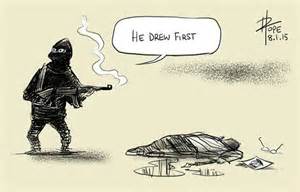
A previous attack in Paris on Charlie Hebdo inspired a great cartoon by Australian David Pope- He drew first. An online search should bring it up. I know cartoonists will hit back against this atrocity. I leave you with this Sandburg poem entitled Honky Tonk in Cleveland, Ohio, It’s a jazz affair, drum crashes and cornet razzes./The trombone pony neighs and the tuba jackass snorts./The banjo tickles and titters too awful./The chippies talk about the funnies in the papers./The cartoonists weep in their beer./Ship riveters talk with their feet/To the feet of floozies under the tables./A quartet of white hopes mourn with interspersed snickers:/“I got the blues./ I got the blues./I got the blues.”/And . . . as we said earlier:/The cartoonists weep in their beer. But, when they finish weeping, they will pick up their pens and they will be mightier. [insert song]

If you’ve ever had an “off” day, then you will find solace, of sorts, in a bit of verse from Australian poet, Banjo Paterson in our next visit to Quotidia. But our days, weeks, months and years stretch backwards over uncountable eons to the moment of creation and our lives are but brief, evanescent flickers in time that may, if we’re lucky, be illuminated by the incandescence of love. So, lift up your inheritance, which is the whole universe, and if you have the time, come visit me in Quotidia.

Credits: All written text, song lyrics and music (including background music) written and composed by Quentin Bega unless otherwise specified in the credits section after individual posts. Mark Dougherty has a co-writing credit for the song Back To You. Illustrative excerpts from other texts identified clearly within each podcast. I donate to and use Wikipedia frequently as one of the saner sources of information on the web.

Technical Stuff: Microphone- (for the podcast spoken content) Audio Technica AT 2020 front-facing with pop filter)

Microphone (for many of the songs) Shure SM58

For recording and mixing down 64-bit N-Track Studio 9 Extended used

Music accompaniment and composition software- Band-in-a-Box and RealBand 2020 as well as- for some 20 of the songs of year 2000 vintage- I used a Blue Mountains, NSW, studioApproximately 48 Banter folk songs and instrumentals recorded live (“in the round”) with a ThinkPad laptop using the inbuilt mic.

Letters From Quotidia Episode 54 The Younger Son

Letters From Quotidia The Younger Son

Welcome to Letters From Quotidia – a podcast by Quentin Bega for lovers of music, poetry, and the Crack- that most Irish of nouns which may encompass, news, gossip, fun, entertainment, and enjoyable conversation. Quotidia is that space, that place, where ordinary people lead ordinary lives. But where, from time to time, they encounter the extraordinary. For our 54th letter we will ping around the worlds of literature and song. Seamus Heaney and Rudyard Kipling will go to bat for the poets and the gospel writer Luke will supply a parable for our enlightenment. So, if you are ready, attune your senses for they are about to be assaulted.

Entry 54: The Younger Son– What is there outside the skin, the eyes, the ears, the tongue and sense of smell?  Smell, oh, yes, your man Proust would validate that ticket. But books I do love. The Bible, Shakespeare, the canonical poets and great authors; but add to that the songwriters and storytellers who grab you by the lobe of your ear and say- listen, listen, are you deaf or what? Can’t you read? No matter, just sit or stand here and listen. And don’t presume for one minute that it is all about you, despite your uniqueness. Just like you, there are billions of skins, noses, eyes, tongues and ears who yearn for the warmth of the sun, the cooling draught of water, the caress of the breeze, the sweetness of honey and the smell of flowers that makes life such a fine and various thing.

But are you the younger son, the lesser sibling, the undervalued one, the person who has failed to find favour? Whether by gender, politics, primogeniture or…whatever…are you feeling on the outer? Maybe an outsider? Maybe a misunderstood member of a despised group? Perhaps just someone who decided that, hey, I don’t want to think, I don’t want to work, I don’t want to explain, I don’t want to engage, I don’t want to figure in any of your classifications? Who would ever want you? Or to be you?

The great bluesman B.B King sang, No-one loves me but my mother, and she could be jivin’ too. Or another King, Albert by name, reminded so many of us in the classic blues song, Born Under a Bad Sign, that, if it wasn’t for bad luck I wouldn’t have no luck at all. I subscribe to a streaming music service and the song-lists, left to their own are randomised. I drink to try to keep a tightrope traversing run possible within the bravado imparted by alcohol and the buzz generated by the sound bouncing off the walls as I stab at the keyboard, five-fingered, as stuff that miraculously coheres into semi-meaningful text blossoms onto the screen in front of me to the sonic hammer of, for instance, The White Stripes’ Ball and Biscuit as I marvel at the serendipity of the lyrics moaned by Jack White, Let’s have a ball and a biscuit sugar/And take our sweet little time about it/Let’s have a ball girl/And take our sweet little time about it.

The ball-cocaine and biscuit-MDMA are “right now” while the future promise of getting clean serves as an excuse for the persona’s “seventh son” to excuse present-day excess, We’ll get clean together/And I’ll find me a soapbox where I can shout it. Sure you will!  While the desperate among the affluent flagellate themselves with drugs and despair there are other, more desperate people seeking some sort of solace. Huge movements of dispossessed and persecuted men, women and children reach their hands out to the promise given by the enticing siren images of the Western World’s illusion of peace and plenty as they flee from unspeakable barbarities. Let’s have a ball, baby.

Thirty-five years ago, Seamus Heaney wrote a poem entitled From the Republic of Conscience for Amnesty International where we discover that we are all ambassadors by virtue of dual citizenship of our native land and the Republic of Conscience where their sacred symbol is a stylized boat./The sail is an ear, the mast a sloping pen,/the hull a mouth-shape, the keel an open eye. We learn that we must act rather than turn away and, rather than remaining silent in the face of injustice to speak on their behalf andno ambassador would ever be relieved.

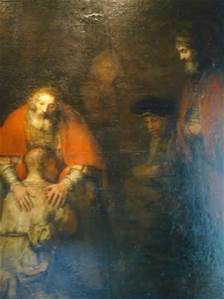
The Bible provides one of the richest sources of material for writers. The parable of The Good Samaritan clearly applies here. Yet it seems to be a puzzling conundrum to the adult political world, largely, although most children get it without too much of a struggle. I have never been inspired to transmute it into song. Or not yet, anyway. This is not the case, though, with another parable which inspired the song at the end of this entry.In the gospel of Luke can be found the parable of The Prodigal Son. And lots of artists, musicians and writers have found this strange and beautiful story. And made something of it.

Here’s a stanza from Rudyard Kipling’s take on the parable: My father glooms and advises me,/ My brother sulks and despises me,/ And Mother catechises me/ Till I want to go out and swear./ And, in spite of the butler’s gravity,/ I know that the servants have it I/ Am a monster of moral depravity,/ And I’m damned if I think it’s fair! The Irish Rover, by The Dubliners, was a favourite single of mine for fifty years and more, and I have sung it off and on in a variety of venues in the decades since: I’ve been a wild rover for many’s the year/ And I’ve spent all me money on whiskey and beer…these lines are more autobiographical than I’d wish, alas. The last verse references the parable, I’ll go home to me parents, confess what I’ve done/And I’ll ask them to pardon their prodigal son. Of course, no parents for me to go home to so all I do is sing the song, drunkenly. [insert song]

Well, Quotidiers, time to hit the road again and move to another part of this strange realm. Among the minstrels, troubadours and strolling players we’ll encounter will be Turlough O’Carolan, the great Irish blind harper, blues legend Robert Johnston and Country icon Hank Williams who will give us a wave as we join forces with a donkey, a dog, a cat and a rooster as they concoct a cunning plan to get the best of a bunch of criminals. Oh! If only the real world had as pleasing a resolution as one of Grimm’s Fairy Tales.

Credits: All written text, song lyrics and music (including background music) written and composed by Quentin Bega unless otherwise specified in the credits section after individual posts. Illustrative excerpts from other texts identified clearly within each podcast. I donate to and use Wikipedia frequently as one of the saner sources of information on the web.

Technical Stuff: Microphone- (for the podcast spoken content) Audio Technica AT 2020 front-facing with pop filter)

Microphone (for many of the songs) Shure SM58

For recording and mixing down 64-bit N-Track Studio 9 Extended used

Music accompaniment and composition software– Band-in-a-Box and RealBand 2020 as well as- for some 20 of the songs of year 2000 vintage- I used a Blue Mountains, NSW, studioApproximately 48 Banter folk songs and instrumentals recorded live (“in the round”) with a ThinkPad laptop using the inbuilt mic.
Letters From Quotidia Episode 53 How Did We Get This Way?

Letters From Quotidia How Did We Get This Way?

Welcome to Letters From Quotidia – a podcast by Quentin Bega for lovers of music, poetry, and the Crack- that most Irish of nouns which may encompass, news, gossip, fun, entertainment, and enjoyable conversation. Quotidia is that space, that place, where ordinary people lead ordinary lives. But where, from time to time, they encounter the extraordinary.

Entry 53: How Did We Get This Way?– Have you ever been young? Have you ever drunk the elixir of youth? Have you ever had the misfortune to have lived through that magical age- to come to the horrible dreams that feature death, disappointment, dreary realisation that this dreck is all just a shoddy illusion? In other words, have you ever grown older, wiser, more balanced, mature, philosophical and last, but not least, quietly resigned to the inevitability of decline that caused a young Welsh poet named Dylan Thomas to write in 1947, at the age Christ was crucified, the wonderful poem, Do Not Go Gentle Into That Good Night?

In an ageing demographic, where there is so much conversation-(oh, how I hate that word now! I can remember when the word meant a stress-free and friendly exchange between equals, but learning in this century that it means, instead, an amalgam of an inquisition and an accusation). But what about those advantages of being a senior citizen (all those really cheap rail passes and so on). I question why I was born into an epoch that failed to see that being young, strong and free was as good as it ever would ever get in our universe as presently constructed.

In 1975, I was raging in Wollongong, in my mid-twenties, and as good as ever I would get- in some ways, anyway. At that time, nearly ten years into my apprenticeship as a songwriter (part-time) and three years into my day job as a teacher at Warrawong High School, I reflected on aspects of my own life. I had a wife who was working, a daughter, just at school, and a son at pre-school. Finely attuned to the lives of my heroes, who were only a few years older that myself, I chafed under the restrictions that were an amalgam of futile hopes, a little knowledge and less ability, that would never, ever have amounted to much more that a pile of futile fantasies.

I can vaguely remember a drunken conversation in a toilet with a guy who took exception to something I had said earlier in the night at Collegians on our inaugural concert. Instead of sitting down with Robert Sheldon from The New York Times for a life-changing interview, I found myself placating this psycho who tried to insert himself into our embryonic folk band on the grounds that he was a great tambourine player. Then, fast-forward to another weekend, up in Sydney, where I bought Dylan’s Blood On The Tracks and sat drinking a coffee, reading the liner notes and knowing that there were several levels of existence between people like me and the guy from Minnesota who changed the world of popular music.

Then, later, of course, I listened to the album. Now, I could have just rushed up to the headland on which was situated the lighthouse at Wollongong and hurled myself over the cliff onto the colourful rocks below. Instead, I wrote this song. Guess what? A man who married in his early twenties to the love of his life, had two children in quick succession and had no clue as to what all of this meant and consequently got so much wrong, somehow had the temerity to put pen to paper and presume to engage in the whole process of telling the universe that, despite the preponderance of huge  pre-existing talent and random black holes and super-novae and whatever else the physicists and mathematicians can conjure out of the numbers, that here is something that is worth telling.

I can remember, too, trying to make a deal with the universe when I knew, in 1964, that I was leaving the paradise that was Aruba, to return to an unknown quantity that was the Ireland of the mid- 1960s. I tried (not for the only time) to make a deal with God. I knew, as a good Catholic, that I was irremediably sinful but I made a pact at 13 years of age that I would take all the crap coming to me right now, and, in return, much later, have the pleasures of beatification. What a crock. It took decades for me to realise that there had been a marvellous and easily available cornucopia that was sitting there in plain sight that was as clear as the heavens above.

As I looked out over the lagoon to the distant mountains of Venezuela I did not realise, then, that I was witnessing the light-show of Catatumbo lightning which is a unique meteorological phenomenon high up in the storm clouds providing a spectacular sight for those close to it and which can be seen up to 500 kilometres away in Aruba, where, as a young boy, I witnessed the flashes of silent light and thought nothing of it. To learn that it was a unique meteorological event more than fifty years after observing it just reinforces the idea that we really don’t know very much at all. So, I hope you forgive me from shouting at the top of my voice: “For God’s sake, remember why we are here on this good earth: Do not go gentle into that good night… Rage, rage against the dying of the light.” [insert song]

The Kings- BB and Albert, Jack White, and that fine Irish folk group, The Dubliners, find a refuge in the 54th Letter From Quotidia. Seamus Heaney reminds us that we are all ambassadors from the Republic of Conscience. Rudyard Kipling, a somewhat overlooked and underestimated poet, gives his grimly sardonic take on the parable of The Prodigal Son, while over in the corner of the pub we see the narrator giving a boozy rendition of The Wild Rover. So if you need refuge from the craziness of where you are, come to Quotidia where your visa will be issued without charge and you cannot outstay your welcome.

Credits: All written text, song lyrics and music (including background music) written and composed by Quentin Bega unless otherwise specified in the credits section after individual posts. Illustrative excerpts from other texts identified clearly within each podcast. I donate to and use Wikipedia frequently as one of the saner sources of information on the web.

Technical Stuff: Microphone- (for the podcast spoken content) Audio Technica AT 2020 front-facing with pop filter)

Microphone (for many of the songs) Shure SM58

For recording and mixing down 64-bit N-Track Studio 9 Extended used

Music accompaniment and composition software- Band-in-a-Box and RealBand 2020 as well as- for some 20 of the songs of year 2000 vintage- I used a Blue Mountains, NSW, studioApproximately 48 Banter folk songs and instrumentals recorded live (“in the round”) with a ThinkPad laptop using the inbuilt mic.

Letters From Quotidia Postcards Edition 13

Letters From Quotidia Postcards Edition 13

Letters from Quotidia Postcards Edition 13

Welcome to Letters From Quotidia, the Postcards edition, number 13, a podcast by Quentin Bega where you will hear Banter, a traditional Irish folk group from Sydney’s outer west, present four tunes and songs drawn from the traditions of the English-speaking world. And, as always, Quotidia is that space, that place, where ordinary people lead ordinary lives. But where, from time to time, they encounter the extraordinary.

Two Irish Tunes. In 1974 , my wife bought me a small round-backed mandolin I lusted after from the music shop at the top of  Crown Street, Wollongong. I started plinking on it and after a time found that I could string the notes of these hornpipes together fairly accurately.  Of course, I slavishly followed the example of The Dubliners from a record of theirs which I played repeatedly to get the gist of the tunes. When Seannachie formed, I duetted with the gun mando player from that group- one Bertie McKnight- and for the next few years it became a staple of our performances. When the group, Banter, re-formed (again) just a few months ago, I re-introduced the hornpipes to the group. Why we hadn’t played them before remains one of life’s little mysteries because they are great tunes. Anyway, in this formation, I play guitar while the tunes are carried aloft by father and son on mandolin and fiddle respectively as the group’s main singer batters away on bodhran to mark the tempo. [insert tunes]

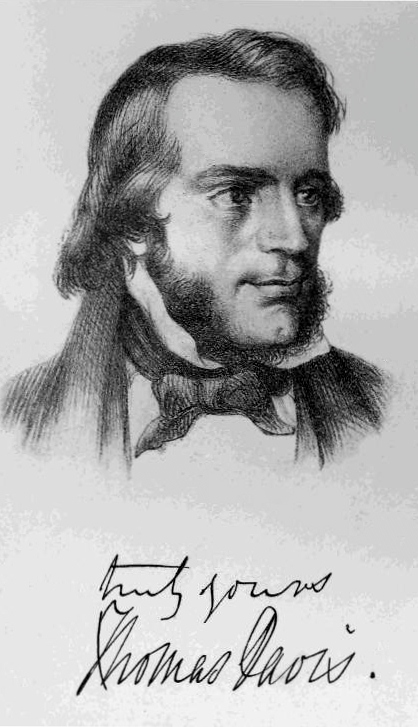
A Nation Once Again. Thomas Davis, one of the main shapers of Irish identity, wrote this stirring ballad in the 1840s, making it one of the early Irish folk songs. He believed that songs were more effective than political harangues. It is notable for its classical references: for example, the 300 men  of the song’s first verse recalls the valiant Spartans at the battle of Thermopylae in 480 BC who, while losing their lives in defence of ancient Greece, laid the foundations of the classical period and all its glories- of which we are the fortunate beneficiaries. While some of the references may be alien to listeners in the 21st Century, the meaning (and emotion) of the song contained in the choruses is unmistakable.  [insert song]

Three Score and Ten. The events depicted in the song date to 1889 when fifteen fishing vessels and seventy or more men and boys were lost in storms off the Yorkshire coast. No one knows, definitively, who wrote the original song, but I agree with the sentiments I read somewhere that the song belongs to the people of the fishing ports and the families who suffered losses to the North Sea gales that have taken so many. Three score and ten, of course, is a trope for the length of human life. The magnificent King James Version expresses in Psalm 90, The days of our years are threescore years and ten;/ and if by reason of strength they be fourscore years,/ yet is their strength labour and sorrow;/ for it is soon cut off, and we fly away. [insert song]

Liverpool Lou. The Liverpool folk/poetry band The Scaffold produced a version of Behan’s song “Liverpool Lou” in 1974 which became a top 10 hit in the UK and spawned covers in various languages across Europe. On the original Scaffold pressing, the writing credits were incorrectly attributed to Paul McCartney who had produced the record on behalf of his brother Mike McGear.

Behan advised the relevant authorities and had his rights to the song reinstated quickly, receiving an apology from McCartney; Behan accepted McCartney’s explanation that his mother had sung the song and he thought it was a traditional work. Later pressings of the song were then correctly credited to Behan; the early McCartney-labelled pressings are particularly rare and collectible.

In a well-publicised interview, John Lennon dismissed the 1960s folk scene in his own country, describing it as “College students with pints of beer going hay-nonny nonny” but in the same breath, he praised Behan, from neighbouring Ireland, whom he said he liked. On Desert Island Discs in 2007, Yoko Ono selected Behan’s “Liverpool Lou” as her husband had sung it to their son as a lullaby. [notes above taken from that wonderful site, Wikipedia- donate, if you can.]One of Banter’s main singers, Jim, usually fields this one, but, because of COVID restrictions in force here in Sydney, guess who ends up singing it on this release? By the way, I’ve recorded, more than one of the songs that are rightfully Jim’s or Sam the Man’s but I don’t know if I want to give them back now…[insert song]

The 14th Postcard will start with a reel to kick off an exploration in song of three  port cities of the British Isles on the Irish Sea: Belfast, Dublin and Liverpool via the fine compositions, McClory featuring Sam, Cross Me Heart, featuring Jim, and Whiskey on a Sunday, featuring me.

Credits: All written text, song lyrics and music (including background music) written and composed by Quentin Bega unless otherwise specified in the credits section after individual posts. Illustrative excerpts from other texts identified clearly within each podcast. I donate to and use Wikipedia frequently as one of the saner sources of information on the web.

Technical Stuff: Microphone- (for the podcast spoken content) Audio Technica AT 2020 front-facing with pop filter)

Microphone (for many of the songs) Shure SM58

For recording and mixing down 64-bit N-Track Studio 9 Extended used

Music accompaniment and composition software– Band-in-a-Box and RealBand 2020 as well as- for some 20 of the songs of year 2000 vintage- I used a Blue Mountains, NSW, studioApproximately 48 Banter folk songs and instrumentals recorded live (“in the round”) with a ThinkPad laptop using the inbuilt mic.
Letters From Quotidia Episode 52 My Good Friend Joe

Letters From Quotidia My Good Friend Joe

Welcome to Letters From Quotidia – a podcast by Quentin Bega for lovers of music, poetry, and the Crack- that most Irish of nouns which may encompass, news, gossip, fun, entertainment, and enjoyable conversation. Quotidia is that space, that place, where ordinary people lead ordinary lives. But where, from time to time, they encounter the extraordinary.

Entry 52: My Good Friend Joe- Felix Randal the farrier, O is he dead then? my duty all ended,/Who have watched his mould of man, big-boned and hardy-handsome/Pining, pining, till time when reason rambled in it, and some/Fatal four disorders, fleshed there, all contended? This portrait of a blacksmith from the late 19th Century written in 1880 by the poet Gerard Manley Hopkins was the inspiration of a song I wrote 120 years later.

I did not replicate the Italian sonnet structure or rhyme scheme, I did not replicate the tender pastor/parishioner relationship obtaining in the poem, I did not replicate the subtle theology of the original- I did not even replicate the fact that the subject of the poem had ceased to be! To be frank- all I did was steal a feeling, sense of mortality, a realisation that we are all leaves trembling on the tree of life. False pretences you may shriek. False? No! Pretences- now that is a different matter! All that I know is that the song’s first line blossomed in my head one night in 2000. Oh is he gone, my good friend Joe, we played in a band…

The latest band I had helped to form was in abeyance and I was hungry for an outlet for…what? Let’s use the word, energy instead of creativity– which sounds way too pretentious. I guess I was reflecting on my journey as a musician over the past thirty- odd years. When I first arrived in Australia, I sought out familiar faces and accents, as all migrants do. In 1973 I was invited to a St Patrick’s do at Collegians club in Wollongong. By that time I had had a few months to find my feet and I made a few contacts among the Irish contingent on the South Coast.

We climbed the stairs to the upper room where trestle tables covered with crepe paper were laid out. The entertainment was…puzzling; an Italian chap with a nice big shiny accordion picked out a few anodyne tunes, among which were a few ersatz Oirish songs written for Hollywood B-movies. I was not happy. Now, I don’t blame the accordion player- he was just gigging. But that anyone would think that this was a celebration of Irish culture just made me gag. So I decided to make sure that the next St Paddy’s day would be more…what? Irish, that’s what I decided. The result was the formation of Seanachie which started to play in a local hotel, as well as cafes and art galleries in the Illawarra- and eventually even played as far afield as Sydney and the Snowy Mountains.

We were OK, thanks, in part, to Joe who had played guitar in various bands in and about Strabane, Northern Ireland. Along with him was his mate Bertie who was a wiz on the mandolin as well as a whistle player, Johnny. The main singer was a Londoner of Irish descent called Tony. I was a bit of a Jack of all trades, playing a bit of guitar, banjo, mandolin, bodhran and whistle which I was struggling to learn that year. We weren’t quite ready for a full concert and our first appearance at Collegians was, shall we say, a limited success- limited, that is, to our loved ones who were determined not to rub too much salt into the wounds.

We did get better, but who wants to hear about success. You know, nothing is really ever old. In 1990, I was appalled on St Patrick’s Day, in a club in north Queensland, to hear the wife of a big car dealer in the Burdekin making mockery of the Irish accent as she performed what can only be described as a “blackface” rendition of The Spinning Wheel. She meant well, of course. And I classify her as a kindred spirit of Ruby Turpin in Flannery O’Connor’s short story, Revelation.

We may talk about sickness in the soul or the spirit but nothing concentrates the mind so much as imminent and grave threats to the body.Illness struck down Felix Randal, the hulking blacksmith, who had gloried in his physical size and strength. The diminutive Jesuit priest, Hopkins, provided pastoral and sacramental care for the dying man, Sickness broke him. Impatient, he cursed at first, but mended/Being anointed and all…/Ah well, God rest him all road ever he offended! Interestingly, the final images of the poem are not of decay, darkness and death but show Felix Randal in his glory days or, as Hopkins puts it,…all thy more boisterous years,/When thou at the random grim forge, powerful amidst peers,/Didst fettle for the great grey dray horse his bright and battering sandal!

As I said at the outset, my song does not try to emulate the linguistic and sonic adventures of the sonnet. Indeed, it is a funeral song without a corpse. Joe is still living, as far as I am aware. It may come to pass that we will again have time to meet somewhere far down the coast, near Eden, where we will fish from the beach and watch the waves roll in from the South Pacific and later, with fortune providing us with a couple of flathead, we will drink and chat about old times over a fish barbecue as the sun goes down. [insert song My Good Friend Joe]

Letter 53 will be winging its way to you next week. As per usual, tomorrow’s offering is the 13th Postcard and will be all about folk music. But, on visiting Quotidia next Monday, you will be admonished not to go gently into that good night. What else will be revealed? That clueless would be a good title for the narrator’s life in the mid-seventies; and that a meteorological phenomenon witnessed over fifty years beforehand only serves to remind… that we don’t really know very much at all. I’ll see you all then, between the lightning flashes.

Credits: All written text, song lyrics and music (including background music) written and composed by Quentin Bega unless otherwise specified in the credits section after individual posts. Illustrative excerpts from other texts identified clearly within each podcast. I donate to and use Wikipedia frequently as one of the saner sources of information on the web.

Technical Stuff: Microphone- (for the podcast spoken content) Audio Technica AT 2020 front-facing with pop filter)

Microphone (for many of the songs) Shure SM58

For recording and mixing down 64-bit N-Track Studio 9 Extended used

Music accompaniment and composition software- Band-in-a-Box and RealBand 2020 as well as- for some 20 of the songs of year 2000 vintage- I used a Blue Mountains, NSW, studioApproximately 48 Banter folk songs and instrumentals recorded live (“in the round”) with a ThinkPad laptop using the inbuilt mic.
Letters From Quotidia Episode 51 Strange Meeting

Letters From Quotidia Strange Meeting

Welcome to Letters From Quotidia – a podcast by Quentin Bega for lovers of music, poetry, and the Crack- that most Irish of nouns which may encompass, news, gossip, fun, entertainment, and enjoyable conversation. Quotidia is that space, that place, where ordinary people lead ordinary lives. But where, from time to time, they encounter the extraordinary.

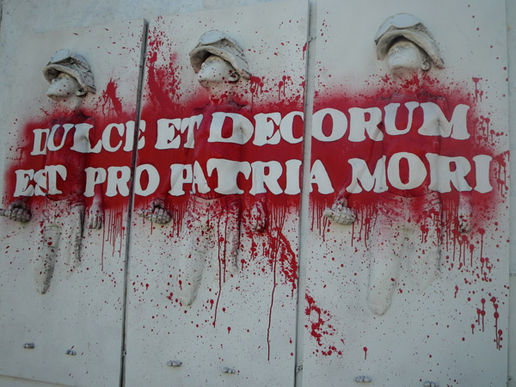
Our 51st letter details a poetic strange meeting. We meet a formidable cleric as he prepares to chastise a bone-idle student and a bunch of student revellers some decades later as they return to their digs in Manchester. Almost sixty years ago, I was required to memorise Dulce et Decorum est as part of my English homework. While I would love to report that I did so grudgingly- but have lived to cherish the imposition forever- that assertion would be less than truthful. I neglected that piece of homework (and several others, if I am being dragged to the truth.) My English teacher banished me to the study hall during his lessons.

By some unexplained protocol, I should have begged forgiveness and then been re-admitted to the sanctuary of learning that was, in fact, Mr Leahy’s wonderfully enlightening classroom. But it didn’t happen. Being a “newbie”, to use an anachronistic American locution, (and why not, seeing as I was not long returned from Aruba and a US educational system,) I kept on reporting to the study hall for a few weeks. The College President (this was the title given to the Principal of the establishment) found out, somehow, that I was languishing in the study hall, out of class, and sent for me.

By this time, I knew that the gradations of punishment tended to increase in direct proportion to the status of the personage one would have to confront- so you can imagine the fearfulness with which I approached the imposing presidential door. Big Bill, or more formally, Father William Tumelty, gruffly interrogated me about my sojourn in the study hall. I knew, from rugby training that on the northern edge of the college grounds due east of the pitches and piggery, on a knoll overlooking the Sea of Moyle, was a photogenic replication of Golgotha. I was in no doubt that I would be nailed up there as a warning to other recalcitrant avoiders of homework. Did I cry? No. At that age, and, with just a few weeks of learning that you were a snivelling suck-up if you reacted to the cane, I resorted to the age-old student defence of limitless ignorance- helped, of course, by the truth that it was not really forced.

So, I was returned to class, Big Bill having determined that I was little more than a blithering idiot and therefore having been punished sufficiently by just being myself. A lucky escape, I told myself. And, while I never actually memorised the great poem, Dulce et Decorum et cetera, I grew to love the poetry of Wilfred Owen. One of the most moving, for me, was Strange Meeting, which details the meeting in Hades of two opposing soldiers. The masterful handling of pararhyme creates a haunting, otherworldly soundscape as we follow one of the protagonists deep into the underworld and feel his dislocation as he comes upon one who leaps up With piteous recognition in fixed eyes,/Lifting distressful hands, as if to bless./And by his smile, I knew that sullen hall,/ By his dead smile I knew we stood in Hell. “Strange friend,” I said, “here is no cause to mourn.” /“None,” said that other, “save the undone years,/The hopelessness. Whatever hope is yours,/Was my life also; I went hunting wild/After the wildest beauty in the world,/Which lies not calm in eyes, or braided hair,/But mocks the steady running of the hour…

That Wilfred Owen, at the age of 25, could write such poetry- poetry that would bear comparison with his compatriots, Keats and Shelley, is one of the great treasures of literature, and one of the great tragedies; that, like the incomparable Keats and Shelley, he would perish, like them, still in his twenties. “I am the enemy you killed, my friend./I knew you in this dark: for so you frowned/Yesterday through me as you jabbed and killed./I parried; but my hands were loath and cold./Let us sleep now. . . .” The pity of war– that phrase is found in the poem and has been engraved in hearts and minds in the decades since it was written. The title would form the germ of an idea for a song I would write fifteen years later. As a teacher now myself, at Ballymena Academy, having recently returned from Australia, I formed an easy relationship with a bunch of students who were interested in music and had won through to the finals of a UK music contest being held in Manchester.

They asked the powers that be that I accompany them to the contest. I can remember workshopping lyrics with them in the bus to the airport- they were still short one original composition for the contest. Typical students- but they had won through to a prestigious, nationwide event, where one of the judges was John Entwhistle of The Who. And they were placed fourth- not bad for a little pickup school band from Northern Ireland. The pressure of the process helped me to write the song at the end of this entry. We were in digs in Manchester University and I sat up with my notepad and guitar and, while the band were out clubbing in central Manchester, I struggled with the lyrics and chords and finally, about 4:00 am, finished, just about when the student revellers were returning. [insert song Strange Meeting]

For letter 52 we will have a look at a blacksmith’s life as a fable for mortality. We will visit the Collegians Club in Wollongong in the early seventies and witness the genesis of an Irish Folk group. And finally, how would you like to have a funeral song written about you while you are still hale and hearty? In Quotidia, such things are far from unusual, so, pandemic restrictions allowing, hop aboard the coach which will deliver you to the Terrapin Station.

Credits: All written text, song lyrics and music (including background music) written and composed by Quentin Bega unless otherwise specified in the credits section after individual posts. Mark Dougherty has a co-writer credit for the song Strange Meeting. Illustrative excerpts from other texts identified clearly within each podcast. I donate to and use Wikipedia frequently as one of the saner sources of information on the web.

Technical Stuff: Microphone- (for the podcast spoken content) Audio Technica AT 2020 front-facing with pop filter)

Microphone (for many of the songs) Shure SM58

For recording and mixing down 64-bit N-Track Studio 9 Extended used

Music accompaniment and composition software- Band-in-a-Box and RealBand 2020 as well as- for some 20 of the songs of year 2000 vintage- I used a Blue Mountains, NSW, studioApproximately 48 Banter folk songs and instrumentals recorded live (“in the round”) with a ThinkPad laptop using the inbuilt mic.

Letters From Quotidia Episode 50 Since You Walked Out of My Life

Since You Walked Out of My Life

Welcome to Letters From Quotidia – a podcast by Quentin Bega for lovers of music, poetry, and the Crack- that most Irish of nouns which may encompass, news, gossip, fun, entertainment, and enjoyable conversation. Quotidia is that space, that place, where ordinary people lead ordinary lives. But where, from time to time, they encounter the extraordinary.

Entry 50: Since You Walked Out of My Life- This song would have been the subject of entry one had this journal been organised chronologically according to date of song composition. But it’s fifty! And if I wind the clock back fifty-odd years (and very odd they have proved to be too!), I see a gawky, 16-year old with acne and a cheap guitar trying to impress his girl-friend (now wife) with his prowess on the fretboard. This is made rather difficult by the high action and rusting strings of the instrument and low degree of skill of the guitar’s owner. The high action made it difficult to hold down the chords with any facility or, indeed, accuracy and the teenage show-off made much of his ability to play runs on the top two strings (the thinnest of the bunch) that made a modicum of musical sense.

Being a mid-teen and therefore very cynical and worldly-wise I cracked on that I was beyond the appreciation of country music having thrown my lot in with the Stones, Beatles, Who and any rock or pop act that was current. Acts from my younger and more foolish life, shared with parents and older siblings, such as Hank Williams, Jim Reeves, Marty Robbins and Johnny Cash were thoroughly scorned and discounted. Strange, then, that my first composition was recognisably of just that despised genre. It was a parody, yes, and, as it turns out, incomplete, for I had only the first section, lyrically and musically, when first I flashed my song-writing credentials to my mildly amused partner.

It took another dozen years to add a couple of sections to make it more than a fragment. So what made me return to the abhorred artefact time and time again? Not a rhetorical question, by the way: I really don’t know. Not entirely. In the mid-sixties, confusion reigned in my world and on my horizons. In my English classroom, under the magisterial Mr Leahy, I was struggling to find anything of interest in L.P. Hartley’s The Go-Between. More people know the opening line of the novel than anything at all of what transpires in that work of fiction; all together now: The past is a foreign country: they do things differently there.

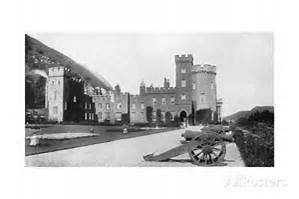
They certainly did at Garron Tower, the colloquial name for St MacNissi’s College, a Catholic grammar school, situated on a plateau approximately 200 feet above the famous Antrim Coast Road overlooking the North Channel and out towards Scotland and the Mull of Kintyre. Built as a summer residence by Frances Anne Vane, Marchioness of Londonderry in the style of an English castle, the  property was acquired by the Catholic Bishop of Down and Connor in 1950 for use as a boarding school for boys as part of a long-term strategy for combating the sectarian stranglehold on higher education by the Protestant ascendancy of the Northern Ireland state-let, which had been established in 1921.

I notice in one of the posts about the place that it was compared to Hogwarts.  Mmm. Perhaps…it seems to have been magically co-located in time and space because there are two wildly divergent narratives about my Alma Mater: one upholds a glowing testament to the saying that schooldays are the best days of your life and another that would, if verifiable, be the subject of judicial sanctions of the graver kinds.

I know that when I arrived there in 1964 as a boarder, from my expatriate American Junior High School in Aruba I was shocked by the regimentation, bullying and corporal punishment that were par for the course. However, I survived because I became a day-boy in 1965 when my parents returned from overseas and, in any case, I threw my lot in with the smokers, gamblers and drinkers who formed their own protective clique.

Now, like Leo Colston, the protagonist of The Go-Between, I am in my mid-sixties, looking through my old things, awakening strange memories from that foreign country. A faded photograph sparks a sudden recollection: a winter scene from 1964 of a bunch of us meeting at a secluded spot, after dinner and before study. It is dusk: we are surrounded by trees. There is a headstone marking the resting place of Urisk, the faithful dog of the original owner, the Marchioness of Londonderry.

It reads, in part, Deaf to all else his mistress’ voice he knew, Blind though he was, his step to her was true. So strong an instinct by affection fed, Endured till Urisk’s vital spirit fled. Stoop grandeur from thy throne ye sons of pride, To whom no want is known, nor wish denied. A moment pause, and blush, if blush you can, To find in dogs more virtue than in man. And share, ‘midst all your luxury and pelf’, one thought for others out of ten for self’.

We light our cigarettes, cupping them in our covert hands, thinking that we have fooled the patrolling priests who amble below, as if in prayer, around the circular path in front of the imposing façade of the College, past the seven cannon pointing out over the North Channel at the future. [insert song Since You Walked Out of My Life]

In Letter 51 you are invited to share in the trepidation felt by a quivering school-boy as he awaits the judgement of a stern cleric and wonder anew how the locus of terror can also be a picture-postcard idyll. If you are partial to lies, then you may wish to cloak them in Latin, such as- Dulce et decorum est, pro patria mori. If you’re really just visiting Quotidia for the music, that’s fine too. You’ll hear a song about a man who walks into a bar and meets his future self- but doesn’t realise it until much, much later.

Credits: All written text, song lyrics and music (including background music) written and composed by Quentin Bega unless otherwise specified in the credits section after individual posts. Illustrative excerpts from other texts identified clearly within each podcast. I donate to and use Wikipedia frequently as one of the saner sources of information on the web.

Technical Stuff: Microphone- (for the podcast spoken content) Audio Technica AT 2020 front-facing with pop filter)

Microphone (for many of the songs) Shure SM58

For recording and mixing down 64-bit N-Track Studio 9 Extended used

Music accompaniment and composition software– Band-in-a-Box and RealBand 2020 as well as- for some 20 of the songs of year 2000 vintage- I used a Blue Mountains, NSW, studioApproximately 48 Banter folk songs and instrumentals recorded live (“in the round”) with a ThinkPad laptop using the inbuilt mic.

Letters From Quotidia Episode 49 Old Fool

Letters From Quotidia Episode 49 Old Fool

Welcome to Letters From Quotidia – a podcast by Quentin Bega for lovers of music, poetry, and the Crack- that most Irish of nouns which may encompass, news, gossip, fun, entertainment, and enjoyable conversation. Quotidia is that space, that place, where ordinary people lead ordinary lives. But where, from time to time, they encounter the extraordinary.

In the 49th letter from Quotidia, fools have the run of the place- but not without consequence. The Ediacarans ruled the roost for 100 million years or so. And a certain Mrs Turpin thought she was queen of the town until she had a book thrown at her. Just as we need our outlaws, we need our fools. How else could we avoid despair at being the scrapings of the barrel, the lowest of the rungs and the humblest of doormats? In our efforts to avoid relegation to the bottom we may, of course, have missed our apotheosis. So, then, who are our fools? Let’s start early, before memory, before humanity- a long distance in the past.

Let us meet the Ediacarans. They arose 600 million years ago, ruling the earth; like us, multicellular entities that lived by absorbing nutrients from their surroundings. They prospered in their Garden of Ediacara for untold eons, in their fool’s paradise until…well, until the Cambrian explosion- a 25-million-year event that saw the arrival of most of the modern animal families: vertebrates, molluscs, arthropods, sponges and jellyfish.

All that remains of the Ediacarans are delicate imprints of their fossilised shapes preserved in sand or ash that look, in miniature, like spinning galaxies, far off in interstellar space. Our fools, in evolutionary terms, then, are those fossilised images which remind us of the spiral galaxies turning relentlessly in the unreachable universe beyond. What rendered them mere remnants was the arrival of entities that did not just passively attach themselves to a rock and suck life from the surrounding environment. Things that could move independently and sustain themselves by eating other organisms began to roam around the Garden of Ediacara.

The rest is history, as they say. Some say we are within a few generations of joining the Ediacarans because of the rise of intelligent machines. A.I. is the sexiest new frontier according to some, and our worst nightmare, according to others. But, in the interregnum, I would like to celebrate humanity and its combination of wisdom and folly, laughter and grief.

The Bible has quite a lot to tell us about wisdom and folly: Proverbs 16:16 reminds us,How much better to get wisdom than gold, to choose understanding rather than silver! So, then, what choices have you made? If that is awkward, how about what Proverbs 18:7 has to say, a fool’s mouth is his ruin, and his lips are a snare to his soul.  Listening, shock jocks? Of course not! Too much gold and silver on offer!

Truth’s a dog must to kennel; he must be whipp’d out, when Lady the brach may stand by th’ fire and stink. Oh, yes. Shakespeare, as usual, puts it best. The Fool in King Lear is one of the glories of world literature, Have more than thou showest,/ Speak less than thou knowest,/ Lend less than thou owest,/ Ride more than thou goest,/ Learn more than thou trowest,/Set less than thou throwest. This is not folly, but wise advice.

A faithful servant of the beleaguered king, the Fool knows that the old ways are under threat and says, I would fain learn to lie. King Lear, using the royal we, replies, An you lie, sirrah, we’ll have you whipp’d. The fool, seeing more clearly than any of those around him retorts, I marvel what kin thou and thy daughters are. They’ll have me whipp’d for speaking true; thou’lt have me whipp’d for lying; and sometimes I am whipp’d for holding my peace. I had rather be any kind o’ thing than a fool! And yet I would not be thee, nuncle. Indeed, who would want to be Lear as he faced the destruction of everything he had known and believed. Fools, and other damaged individuals, have licence to speak the unspeakable truth to the mightiest in the land, even though they may face whipping or worse.

Flannery O’Connor’s short story, Revelation, set, initially, in a doctor’s waiting room features Mrs Ruby Turpin, who is a complacent and pious hypocrite, certain of her own rightness and assured of her throne among the celestial throng. As she converses with others in the waiting room she is somewhat disconcerted by the intensity with which a young female student, who is prone to psychotic episodes, looks at her. Then, without warning, she throws a book at Mrs Turpin, hitting her over the eye; she then launches herself at the corpulent woman attempting to strangle her. She is subdued by the doctor and nurse and injected with a sedative.

The stunned Mrs Turpin approaches the supine girl: There was no doubt in her mind that the girl did know her, know her in some intense and personal way, beyond time and place and condition. “What you got to say to me?” she asked hoarsely and held her breath, waiting, as for a revelation. The girl raised her head. Her gaze locked with Mrs. Turpin’s. “Go back to hell where you came from, you old wart hog,” she whispered.

The words resonate in her with prophetic force and she has a vision that evening on her property at sunset where she sees a vast procession of those she considered beneath her leaping and shouting as they made their way up to heaven-ahead of the likes of Mrs Turpin. If you are an old fool like me, then this song should resonate. If not, wait a while until you qualify. [insert song]

The next letter- numbered the big five-oh tumbles us backwards in time to a pimple-popping teenage boy trying to impress his girlfriend with his guitar and songwriting chops and to his faux castle boarding school overlooking the North Channel of the Irish Sea. We may be affected by the sentiments of the Marchioness of Londonderry for her faithful dog, Urisk inscribed on a large stone marker, which the narrator and his mates used as a meeting place for a surreptitious smoke after supper. So, if you are a slave to nicotine, bring a furtive fag to our meeting place in Quotidia.

Lyrics to the song Old Fool

A, E, D, Bm etc

I’m often told that no fool compares to an old fool

And I concede this rule of thumb applies to me

Since I could walk I’ve fallen down

Since I could talk my foot in mouth

I toss the coin call heads and tails- it lands on its edge

I have been called a multitude of painful names

I won’t detain you long as I recite, as I recall for you this hurtful litany

You are a meathead, sucker, sap, a drongo dupe, a Charlie chump,

You zany rogue, you fathead goose, you waste of space

Get on your bike boy hit the road out of my sight now sling your hook

I’ve had the book thrown at me so many times

I am immune from all your looks of deep disdain

I can absorb your sneers and calumnies, the libels and the lies with equanimity 

Philosophers are grave and gray the troubadours sing sweet and gay

The lovers swoon, the soldiers fight, in to the night

Professors teach the clergy preach, the business men they buy and sell

While doctors seek to make us well-

(music interlude)

From shadowland I watch the band of motley as it passes by

The carousel, the spinning top- the whirligig

I’m often told that no fool compares to an old fool

And I concede this rule of thumb applies to me…

Applies to me, applies to you

Credits: All written text, song lyrics and music (including background music) written and composed by Quentin Bega unless otherwise specified in the credits section after individual posts. Illustrative excerpts from other texts identified clearly within each podcast. I donate to and use Wikipedia frequently as one of the saner sources of information on the web.

Technical Stuff: Microphone- (for the podcast spoken content) Audio Technica AT 2020 front-facing with pop filter)

Microphone (for many of the songs) Shure SM58

For recording and mixing down 64-bit N-Track Studio 9 Extended used

Music accompaniment and composition software- Band-in-a-Box and RealBand 2020 as well as- for some 20 of the songs of year 2000 vintage- I used a Blue Mountains, NSW, studioApproximately 48 Banter folk songs and instrumentals recorded live (“in the round”) with a ThinkPad laptop using the inbuilt mic.