There’s no fool like an old fool, they say, so what happens when a bunch of oul’ coots gather together to make music? The next batch of posts may enlighten you as to the question just posed and may also, perhaps, enrage or entertain. Anything’s better than a yawn, I guess. And everything that is not that bloody virus is a plus. At the moment we can’t meet as a group, as we are in lockdown, so I have set out a version of songs that are in our repertoire but which have not yet been recorded. With any luck (and, as three of us are north of 70, we’ll need it!) we will be able to resume our normal practice of meeting weekly and playing tunes, singing songs and generally enjoying the crack.
The Sea Around Us– Although he died over 30 year ago, the songs of Dominic Behan continue to be played around the world, especially by Irish bands and performers. Notable songs include, The Patriot Game (which he claimed, with much justification, was plaigarised by Bob Dylan for God On Our Side.), McAlpine’s Fusiliers, of which you’ll find a version elsewhere on the site, and Come Out Ye Black and Tans. He was a committed socialist and republican and he had a wide network of friends and collaborators in the media politics and arts. The verse below, from this song, demonstrates his acerbity and humour: Two foreign old monarchs in battle did join/Each wanting his head on the back of a coin;/If the Irish had sense they’d drowned both in the Boyne/And partition thrown into the ocean. One summer in the mid-sixties, my brother and I hitch-hiked to Bundoran, a holiday town on the Atlantic coast of Donegal. We stopped into a church hall to hear Dominic Behan perform: still a happy memory.
The notes above are taken from another version of the song on this site. A Bit of Banter- 63 features Sam the Man singing for a session we had almost a decade ago. Here, still in lockdown, I felt the urge to set it down again, and I think it can bear the repetition.
There’s no fool like an old fool, they say, so what happens when a bunch of oul’ coots gather together to make music? The next batch of posts may enlighten you as to the question just posed and may also, perhaps, enrage or entertain. Anything’s better than a yawn, I guess. And everything that is not that bloody virus is a plus. At the moment we can’t meet as a group, as we are in lockdown, so I have set out a version of songs that are in our repertoire but which have not yet been recorded. With any luck (and, as three of us are north of 70, we’ll need it!) we will be able to resume our normal practice of meeting weekly and playing tunes, singing songs and generally enjoying the crack.
“Waltzing Matilda” is Australia’s best-known bush ballad, and has been described as the country’s “unofficial national anthem”.
The title was Australian slang for travelling on foot (waltzing) with one’s belongings in a “matilda” (swag) slung over one’s back. The song narrates the story of an itinerant worker, or “swagman”, making a drink of billy tea at a bush camp and capturing a stray jumbuck (sheep) to eat. When the jumbuck’s owner, a squatter (landowner), and three troopers (mounted policemen) pursue the swagman for theft, he declares “You’ll never catch me alive!” and commits suicide by drowning himself in a nearby billabong (watering hole), after which his ghost haunts the site.
The original lyrics were written in 1895 by Australian poet Banjo Paterson, and were first published as sheet music in 1903
The Australian poet Banjo Paterson wrote the words to “Waltzing Matilda” in August 1895 while staying at Dagworth Station, near Winton owned by the Macpherson family.
It has been widely accepted that “Waltzing Matilda” is probably based on the following story:
In Queensland in 1891 the Great Shearers’ Strike brought the colony close to civil war and was broken only after the military were called in. In September 1894, some shearers at Dagworth Station were again on strike. The situation turned violent with the striking shearers firing their rifles and pistols in the air and setting fire to the woolshed at Dagworth, killing dozens of sheep. The owner of Dagworth Station and three policemen gave chase to a man named Samuel Hoffmeister, an immigrant said to have been born in Batavia also known as “Frenchy” Rather than be captured, Hoffmeister shot and killed himself at the 4 Mile Creek south of Kynuna at 12.30pm on 2 September, 1894.
In February 2010, ABC News reported an investigation by barrister Trevor Monti that the death of Hoffmeister was more akin to a gangland assassination than to suicide. The same report asserts, “Writer Matthew Richardson says the song was most likely written as a carefully worded political allegory to record and comment on the events of the shearers’ strike.” (Thanks to that great resource, Wikipedia for the notes above- donate if you can.)
On arriving in Australia, in 1972, this was one of the first Aussie songs I learned. In the mid-70s I played in a group called Currency and here’s where I learned the alternative music to the well-known lyrics. From lockdown, I present a version that has more than a trace of Country music in its iteration.
There’s no fool like an old fool, they say, so what happens when a bunch of oul’ coots gather together to make music? The next batch of posts may enlighten you as to the question just posed and may also, perhaps, enrage or entertain. Anything’s better than a yawn, I guess. And everything that is not that bloody virus is a plus. At the moment we can’t meet as a group, as we are in lockdown, so I have set out a version of songs that are in our repertoire but which have not yet been recorded. With any luck (and, as three of us are north of 70, we’ll need it!) we will be able to resume our normal practice of meeting weekly and playing tunes, singing songs and generally enjoying the crack.
Historically, the song has been referred to in Irish folklore and, since the late sixteenth century, it has been noted in written records—although it is likely that some northern Atlantic fishing crews knew the song before these historical accounts were made. The song is a staple for artists performing live music in Irish pubs. It is often considered to be a drinking song rather than a temperance song. For many people, the Wild Rover is the stereotypical Irish drinking song
“The Wild Rover” is the most widely performed Irish song, although its exact origins are unknown. The song tells the story of a young man who has been away from his hometown for many years. Returning to his former alehouse the landlady refuses him credit, until he presents the gold which he has gained while he has been away. He sings of how his days of roving are over and he intends to return to his home and settle down.
According to Professor T. M. Devine in his book The Scottish Nation 1700 – 2000 (Penguin, 2001) the song was written as a temperance song. The song is found printed in a book, The American Songster, printed in the USA by W.A. Leary in 1845, and spread from Scotland to America from the Temperance movement. There is another USA printed version in the “Forget-Me-Not Songster” (c 1850), published by Locke. An alternative history of the song is suggested by the fact that a collection of ballads, dated between 1813 and 1838, is held in the Bodleian Library
Raymond Daly and Derek Warfield of The Wolfe Tones describe how the fans of Celtic Football Club in Scotland sing The Wild Rover at away matches. The chorus is well known throughout most English-speaking cultures, even among people who have no knowledge of the rest of the song. (Thanks to Wikipedia for the notes above. Do donate to a great site, if you can afford to.)
I first came across this song off the Dubliners 1964 LP and the song was a staple of the dance-halls in rural and metro Northern Ireland. The showbands of the time were nothing if not versatile: able to keep the punters entertained with songs from the Top of the Pops as well as Country staples from the USA. Add to the mix, Irish folk songs and Ceili dance-tunes and you get the idea of what a night out was like in the mid-1960s in Ireland. It was a great time that has, alas, faded into the past.
Sam the Man helms the song in our wee group, Banter, but because the virus has us in lockdown, and, anyway, there are no venues open for live music yet, I get to sing it and share it!
There’s no fool like an old fool, they say, so what happens when a bunch of oul’ coots gather together to make music? The next batch of posts may enlighten you as to the question just posed and may also, perhaps, enrage or entertain. Anything’s better than a yawn, I guess. And everything that is not that bloody virus is a plus. At the moment we can’t meet as a group, as we are in lockdown, so I have set out a version of songs that are in our repertoire but which have not yet been recorded. With any luck (and, as three of us are north of 70, we’ll need it!) we will be able to resume our normal practice of meeting weekly and playing tunes, singing songs and generally enjoying the crack.
This patriotic song dates to the early 19th Century and thus is one of the earliest of the genre in English. On the surface it appears to be a love song. A bower is a seat found in leafy surrounds often used for romantic trysts or meetings- although this arrangement was usually found among the wealthy!
However, in the song, the bower is a symbol for Ireland herself, and the call in the song is for the Irish who have scattered to Europe and America as a result of British retribution during the rebellions in 1798 of the United Irishmen and the Emmet rebellion of 1803 to return to aid Ireland in her need- will you come to the bower.
This aid, according to some, would encompass armed insurrection as well as political agitation, which obviously had to be couched in code to escape the attention of the authorities. (Although, really, were the authorities so thick that they could not spot sedition in the lyrics!)
The song reached America by the 1830s because the tune was played as the Texan army, under General Sam Houston, marched against the Mexican forces led by Santa Anna, at the battle of San Jacinto on April 21st, 1836 which established the independence of Texas. Remember the Alamo! the charging Texans yelled.
Over the years the song may have gained some overlays of reference as successive waves of Nationalists had to escape over the next fifty years. Nevertheless, it remains an early example in both its diction and melody of the patriotic impulse of the Irish and their love of Erin the Green.
The song references great Celtic heroes such as Brian Boru, who successfully repelled the Vikings; powerful clans, such as the O’Neills and O’Donnells as well as political figures such as Daniel O’Connell. It name- checks settlements throughout Ireland such as Dublin, Wexford and New Ross as well as bodies of water such as the lakes of Killarney and Lough Neagh; the rivers also get a mention, the Bann, the Boyne, the Liffey and the broad, majestic Shannon. And what broad-brush Irish song would fail to mention Ireland’s patron, St Patrick. (I am indebted to the website irishmusicdaily.com for some of the info above.)
The group Banter has yet to perform the song in public although it has had an outing in a couple of practices. When the virus thing is a pestilence past, we may well perform it, as it has great words and a rousing melody. I first heard this song from an early Dubliners LP in the late 1960s featuring the incomparable Luke Kelly on vocals. So, again, I here present a lockdown version featuring Band-in-a-Box etc.- which is great to have, but I would prefer having living, breathing musos behind me rather than the digital devices.
There’s no fool like an old fool, they say, so what happens when a bunch of oul’ coots gather together to make music? The next batch of posts may enlighten you as to the question just posed and may also, perhaps, enrage or entertain. Anything’s better than a yawn, I guess. And everything that is not that bloody virus is a plus. At the moment we can’t meet as a group, as we are in lockdown, so I have set out a version of songs that are in our repertoire but which have not yet been recorded. With any luck (and, as three of us are north of 70, we’ll need it!) we will be able to resume our normal practice of meeting weekly and playing tunes, singing songs and generally enjoying the crack.
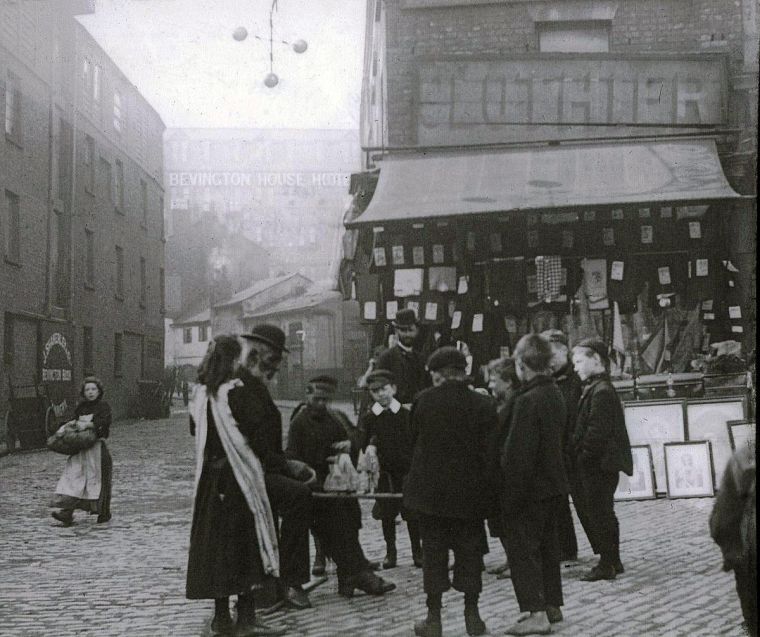
Seth Davy with his dancing dolls,1900 A.D.
The song, written by Glyn Hughes around 1960, is also known as The Lament for Seth Davy, who died in 1902. Seth Davy was a Jamaican who performed in the square near the Bevington Bush Hotel. In the photograph above he can be seen with his dancing dolls entertaining a bunch of kids. The dolls were attached to a plank which he controlled by striking the plank with his hands.
I first heard the song in 1968, by Danny Doyle, who had a hit with it in Ireland. At that time, I was living between Belfast and the Glens of Antrim. I thought it was about Ireland, what with the mention of buttermilk and whiskey. But, when I started to sing the song a few years back I did a bit of research and discovered the true origin and context of the song. You are never to old to learn the truth about something!
The last three posts all cover songs about Liverpool but this is the only one that is native to Liverpool itself. The Leaving of Liverpool probably originates in America and Liverpool Lou was written by noted Irish songwriter, Dominic Behan.
Again, this is a lockdown version of the song. While I really rate the Band-in-a-Box and Real Band software as well as the n-Track recording app, I still prefer standing with my guitar onstage with Jim, my brother-in-law playing the mandolin, Mark, my nephew playing the fiddle and good friend Sam the Man, playing the bodhran. Our appearing in front of a pub or club crowd is still months in the future, I fear. In the meantime…
There’s no fool like an old fool, they say, so what happens when a bunch of oul’ coots gather together to make music? The next batch of posts may enlighten you as to the question just posed and may also, perhaps, enrage or entertain. Anything’s better than a yawn, I guess. And everything that is not that bloody virus is a plus. At the moment we can’t meet as a group, as we are in lockdown, so I have set out a version of songs that are in our repertoire but which have not yet been recorded. With any luck (and, as three of us are north of 70, we’ll need it!) we will be able to resume our normal practice of meeting weekly and playing tunes, singing songs and generally enjoying the crack.
The Liverpool folk/poetry band The Scaffold produced a version of Behan’s song “Liverpool Lou” in 1974 which became a top 10 hit in the UK and spawned covers in various languages across Europe. On the original Scaffold pressing, the writing credits were incorrectly attributed to Paul McCartney who had produced the record on behalf of his brother Mike McGear.
Behan advised the relevant authorities and had his rights to the song reinstated quickly receiving an apology from McCartney; Behan accepted McCartney’s explanation that his mother had sung the song and he thought it was a traditional work. Later pressings of the song were then correctly credited to Behan; the early McCartney-labelled pressings are particularly rare and collectible.
In a well-publicised interview, John Lennon dismissed the 1960s folk scene in his own country, describing it as “College students with pints of beer going hay-nonny nonny” but in the same breath, he praised Behan, from neighbouring Ireland, whom he said he liked. On Desert Island Discs in 2007, Yoko Ono selected Behan’s “Liverpool Lou” as her husband had sung it to their son as a lullaby. (notes above taken from that wonderful site, Wikipedia- donate, if you can.)
One of Banter’s main singers, Jim, usually fields this one, but, because of lockdown in force still here in Sydney, guess who ends up singing it on this release? By the way, I’ve recorded, more than one of the songs that are rightfully Jim’s or Sam the Man’s but I don’t know if I want to give them back now…
There’s no fool like an old fool, they say, so what happens when a bunch of oul’ coots gather together to make music? The next batch of posts may enlighten you as to the question just posed and may also, perhaps, enrage or entertain. Anything’s better than a yawn, I guess. And everything that is not that bloody virus is a plus. At the moment we can’t meet as a group, as we are in lockdown, so I have set out a version of songs that are in our repertoire but which have not yet been recorded. With any luck (and, as three of us are north of 70, we’ll need it!) we will be able to resume our normal practice of meeting weekly and playing tunes, singing songs and generally enjoying the crack.
“(The) Leaving of Liverpool” (Roud 9435), also known as “Fare Thee Well, My Own True Love”, is a folk song. Folklorists classify it as a lyrical lament and it was also used as a sea shanty, especially at the capstan.
It is very well known in Britain, Ireland, and America, despite the fact that it was collected only twice, from the Americans Richard Maitland and Captain Patrick Tayluer. It was collected from both singers by William Main Doerflinger, an American folk song collector particularly associated with sea songs in New York.
Maitland said he learned “The Leaving of Liverpool” from a Liverpudlian on board the General Knox around 1885. His version has the narrator leave Liverpool to be a professional sailor aboard a historical clipper ship, the David Crockett, under a real-life captain, Captain Burgess. This would date his version to between 1863, when John A. Burgess first sailed the David Crockett out of Liverpool, and 1874, when Burgess died at sea.
Tayluer did not say exactly when he learned the song, but he was at sea by 1870, and Doerflinger generally thought his songs were older than Maitland’s. Tayluer did say that he believed the song originated during the Gold Rush, in 1849, and that it concerned a person leaving Liverpool to strike it rich in California and then return.
“The Leaving of Liverpool” has been recorded by many popular folk singers and groups since the 1950s. The Clancy Brothers and Tommy Makem had a top 10 hit with the song in Ireland in 1964. The song has also been adapted by several artists, most notably The Dubliners and The Pogues. (The above info from the wonderful trove of stuff in Wikipedia. Donate to it, as I do, because it is worth preserving as one of the saner sources of knowledge among what you get on other free sites.)
I first heard the song in the mid-1960s from a Clancy Brothers record belonging to my parents. I have had a handwritten version of the lyrics in my song folder for over a quarter of a century and in all that time I have not sung it in public, nor has any of the group, Banter. Don’t ask me why, as it’s a great song. Maybe it is because it got over-sung and over-played in the folk revival in the British Isles in the 60s and 70s?
In any event, I was sitting in lockdown and happened across it as I was going through my folder. I think it deserves another airing- even though dozens of examples of the song are extant out there. I treat it as a lament, rather than the lustier versions that have been favoured by some artists.
There’s no fool like an old fool, they say, so what happens when a bunch of oul’ coots gather together to make music? The next batch of posts may enlighten you as to the question just posed and may also, perhaps, enrage or entertain. Anything’s better than a yawn, I guess. And everything that is not that bloody virus is a plus. At the moment we can’t meet as a group, as we are in lockdown, so I have set out a version of songs that are in our repertoire but which have not yet been recorded. With any luck (and, as three of us are north of 70, we’ll need it!) we will be able to resume our normal practice of meeting weekly and playing tunes, singing songs and generally enjoying the crack.
The Lachlan river runs through some of the best sheep raising areas of western NSW. To this region came the tigers of the shearing trade, the big gun shearers. This song pays tribute to their skill. Calling “tar” was not something you shouted out too loudly, according to Duke Tritton [the writer of The Sandy Hollow Line which I have recorded elsewhere on this site.] The tar was to stop the bleeding when a sheep was cut while being shorn. The same tune is used for ‘The Station Cook’ and ‘The Great Northern Line’ one of Sally Sloane’s songs. The tune is from the Scottish song ‘Musselburgh Fair’. From the singing of A.L. Lloyd. (notes taken from website folkstream.com)
Sheep shearing is probably the most iconic activity in rural Australia. At the start of the wool industry in the early 19th century, sheep were shorn with blade shears, similar to garden clippers. The first authenticated daily tally (amount of sheep shorn in a single day) was 30 sheep by Tome Merely in 1835. By 1892, Jack Howe managed a tally of 321 sheep at Alice Downs in Queensland.
In the intervening period, however, the rise of the wool industry meant that new inventions and processes were introduced to make shearing more time and cost efficient. Patents for shearing machines started to be granted from the 1860s and in 1882, a shearer called Jack Gray became the first man to completely shear a sheep using mechanical shears.
The method that most woolgrowers adopt was the Wolseley stand. Frederick Wolseley was an Irish-born pastoralist who had a sheep station near Sydney. His invention was a handpiece connected to a power source – originally driven by horse power, but later connected to an external engine. The handpiece relieved strain on the shearer’s hand and allowed the wool to be clipped up to three times closer to the skin than blade shearing. The new invention horrified thousands of shearers, who feared that the new efficient method would put many of them out of work. Powerful shearers’ unions were formed and a resolution forbidding union members to work in sheds with non-union workers led to a six-month shearers’ strike which crippled the wool industry in the eastern states of Australia. The woolgrowers held firm and eventually the shearers were forced to return to work, but the action laid the groundwork for the labour movement in Australia.
By 1900, machine shearing was the norm, although it was as late as 1949 when Jack Howe’s blade shearing tally was broken by a machine shearer when Dan Cooper achieved a total of 325 sheep by machine. (from the archives of The State Library of New South Wales)
My first encounter with Australian folk music was back in the mid-1970s when I was a part of a folk trio named Currency Folk, with John Broomhall and Kevin Baker. We played a selection of Aussie folk songs here and there in the Wollongong area. On one notable occasion we played for an audience of wharfies at Port Kembla. They were a tolerant and somewhat amused audience as they watched three twenty-something middle-class teachers sing and emote about the struggles of the Australian worker!
From that time, I have grown to love Australian folk song and have sung a number from this vast repertoire in the decades since. At first, in my more ignorant phase as a twenty-something teacher, I thought that Australian folk music was derivative and inferior to the burgeoning Irish Folk revival that was headlined in the late 1950s with The Clancy Brothers and Tommy Makem, continued with The Dubliners in the 1960s, then Planxty and The Fureys in the 1970s.
But, as I like to say, life is a learning process, or you are merely a dead man walking about and taking up valuable space. I have, over the decades, learned something of the subtleties and ingenious adaptations as words and music from other lands have made their way to Australia and been transformed into an authentic homegrown genre.
And talking about authenticity, this song was best performed, IMHO, by an Aussie called Big Geordie Muir, who sang with us in the mid-1990s at The Henry Lawson Club, in Werrington in western Sydney, of which he was the general manager. He hailed from out by Warragamba Dam, and his roots were proudly Scottish. Here is my lockdown version which I present to you, without too much blushing, and only because of the exigencies caused by that bloody virus…
There’s no fool like an old fool, they say, so what happens when a bunch of oul’ coots gather together to make music? The next batch of posts may enlighten you as to the question just posed and may also, perhaps, enrage or entertain. Anything’s better than a yawn, I guess. And everything that is not that bloody virus is a plus. At the moment we can’t meet as a group, as we are in lockdown, so I have set out a version of songs that are in our repertoire but which have not yet been recorded. With any luck (and, as three of us are north of 70, we’ll need it!) we will be able to resume our normal practice of meeting weekly and playing tunes, singing songs and generally enjoying the crack.
The Jolly Beggarman is believed to be King James V of Scotland, father of Mary, Queen of Scots. He was in the habit of wandering the countryside dressed as a beggar. There are lots of stories about various royals and members of the nobility roaming the roads, streets and lanes of their domain for a bit of excitement.
King James V actually wrote a poem in the 16th Century called The Jolly Beggar on which the verse of the song here is based. The chorus is inspired by the 19th Century Romantic poet, Lord Byron who was mad, bad and dangerous to know! He was one of my favourite poets when I was a teenager- and I still rate him highly today. Here is his exquisite and regretful lyric, We’ll Go No More a-Roving.
SO, we’ll go no more a-roving/So late into the night,/Though the heart be still as loving, And the moon be still as bright/.For the sword outwears its sheath,/And the soul wears out the breast,/And the heart must pause to breathe,/And love itself have rest./Though the night was made for loving,/And the day returns too soon,/Yet we’ll go no more a-roving/By the light of the moon.
Jim, along with Sam the Man, are the main singers in Banter. I am content to be the Bronze Medallist, insofar as singing is concerned, within our group. But, here in lockdown, there is no competition! So, I have taken one of the songs that Jim habitually sings and unashamedly present it here.
There is an interesting contrast between the lusty verses inspired by King James V and the regretful chorus inspired by Lord Byron. I have sought to underpin this by having the vigorous instrumentation of the verse being undercut by the romantic strings in the chorus- see what you think.
There’s no fool like an old fool, they say, so what happens when a bunch of oul’ coots gather together to make music? The next batch of posts may enlighten you as to the question just posed and may also, perhaps, enrage or entertain. Anything’s better than a yawn, I guess. And everything that is not that bloody virus is a plus. At the moment we can’t meet as a group, as we are in lockdown, so I have set out a version of songs that are in our repertoire but which have not yet been recorded. With any luck (and, as three of us are north of 70, we’ll need it!) we will be able to resume our normal practice of meeting weekly and playing tunes, singing songs and generally enjoying the crack.
I first heard this song from the singing of Eddie Furey and piping by Finbar, from, their Transatlantic LP The Dawning of the Day, released in 1972. Written by Gerry Rafferty (he wrote 1978s smash hit Baker Street from his LP City to City and Stuck in the Middle with You, later used in the film Reservoir Dogs.)
Rafferty was born on 16 April 1947 into a working-class family of Irish Catholic origin in Paisley, Scotland. He was a member of a folk-pop group, The Humblebums, along with comedian Billy Connolly who has often recalled this period, telling how Rafferty made him laugh and describing the crazy things they did while on tour. Once Rafferty decided to look in the Berlin telephone directory to see if any Hitlers were listed.
Rafferty went on to have a career that encompassed Britain, Europe, and America. He was widely admired with many friends in the music industry. He died in 2011 after a varied and jam-packed career and, as happens to so many talented musos, after a long struggle with alcohol.
Speaking after the funeral, Charlie Reid of The Proclaimers said: “I think Gerry Rafferty was one of the few people who really successfully straddled the worlds of both folk and popular music. He did it really well and he was respected in both camps.” Barbara Dickson also paid tribute to her friend, whom she described as a “luminous, glorious Scottish musician”.
Finbar Furey, who knew Rafferty for over 40 years, said he “was in a different league completely. He didn’t know how good he was. He was one of the most talented musicians and singers I ever knew but he completely underestimated his own talent. He was a very humble man.” I include the above, gleaned from Wikipedia as a tribute to a truly great talent. I have long sung this song as part of my repertoire.